Mining and quarrying operations depend on a chain of connected activities: drilling, blasting, loading, hauling, crushing and screening. A delay in one stage can affect the next.

Mining and quarrying operations depend on a chain of connected activities: drilling, blasting, loading, hauling, crushing and screening. A delay in one stage can affect the next.
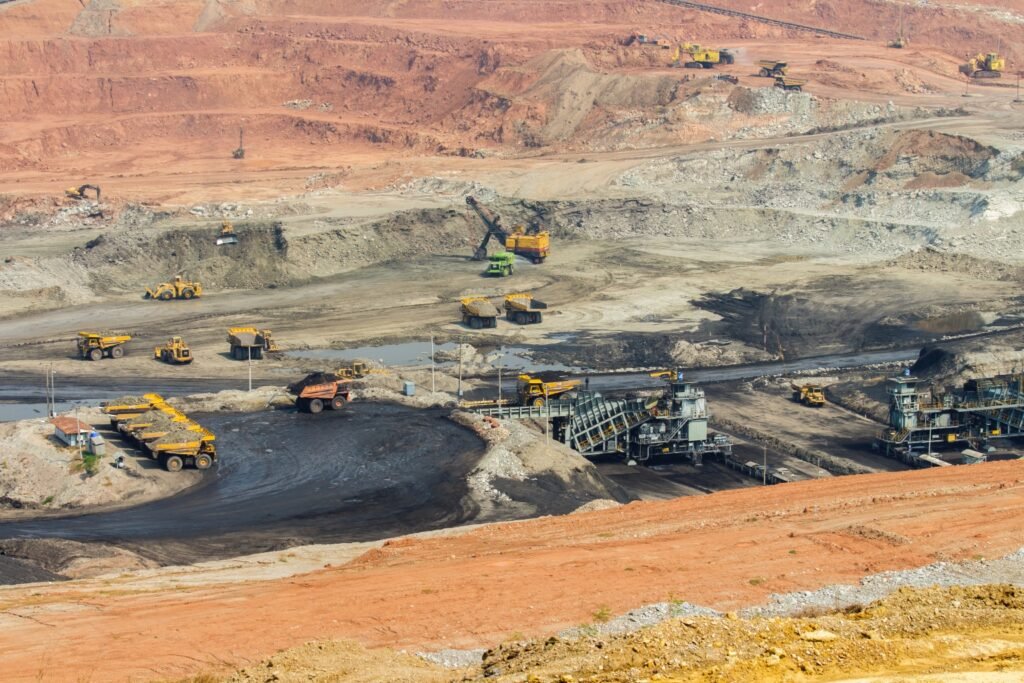
Equipment manufacturers are increasingly adding automation, payload monitoring, fleet-management systems and machine-health technologies to this chain. Some systems are already in commercial use, while others are moving from trials into wider deployment.
The focus is shifting from the capacity of individual machines to the performance of the complete production cycle.
In surface mining and quarrying, drilling establishes the hole pattern for blasting. Hole position, depth and angle influence the fragmentation produced by the blast and can affect downstream loading and crushing.
Epiroc’s current surface-drill portfolio includes the SmartROC C50 for selective mining, aggregate and limestone quarrying. The machine uses COPROD drilling and is specified for 90–140 mm hole diameters, a maximum hole depth of 36 m and a 242 kW engine. Its drill cycle can be automated, including rod handling and feed alignment.
The SmartROC D60 is designed for aggregate and limestone quarries, surface mining and construction. Epiroc specifies 110–178 mm hole diameters, a maximum hole depth of 56 m and a 354 kW engine.
Caterpillar’s Terrain for drilling uses digital drill plans to define hole locations. The system can report drill productivity, availability, utilisation and compliance with the plan, while hole-status information can be shared between drills in real time. Caterpillar also links accurate drilling with more consistent fragmentation and downstream effects on loading and haulage.
Automation is also changing where drilling operators work.
Epiroc’s BenchREMOTE is a remote operator station for surface mining and quarrying. One operator can control up to three compatible SmartROC rigs simultaneously from the station, while the operator remains away from the immediate drilling area.
The system is available for SmartROC models including the C50 and D60. Epiroc describes the application as mining and quarrying drilling, using down-the-hole, tophammer and COPROD methods depending on the machine.
Remote operation can therefore address both equipment utilisation and operator positioning in applications where the drilling area presents additional risks.
Once material is blasted, excavators, hydraulic shovels and loaders transfer it to haulage equipment.
Volvo CE’s India range includes the EC950E crawler excavator. The machine has an operating weight of 89,960–91,840 kg and bucket capacities from 3.9 to 6 m³. Volvo lists applications including quarrying and mass excavation.
Actual production depends on the complete loading cycle. Bucket size is only one factor. Cycle time, material characteristics, digging conditions and truck availability also influence output.
Payload-management systems provide another source of operating information. Komatsu’s current Smart Mining portfolio includes payload management for shovels, loaders and draglines, with real-time payload monitoring, KPI reporting and operator benchmarking.
The haul cycle links the loading unit with the dump point, crusher or stockpile.
Caterpillar’s 794 AC is an electric-drive mining truck with a nominal rated payload of 327 US tons, or 297 tonnes. The truck has 3,500 hp (2,610 kW) of gross power and is available with Cat technology including Product Link Elite and MineStar Command-ready capability.
The distinction between electric drive and battery-electric equipment is important. The 794 AC uses a diesel engine with an AC electric-drive system; it is not a battery-electric truck.
The Cat 793 is a 240-tonne metric payload truck. Its current India specification includes Product Link connectivity, while MineStar Fleet provides monitoring for the hauling operation.
Volvo CE’s A45 articulated hauler has a 42,000 kg payload and 25.5 m³ SAE 2:1 heap body volume. Its Haul Assist package includes On-Board Weighing, which provides real-time payload information.
These systems give operators and fleet managers more information about payload and machine movement during the haul cycle.
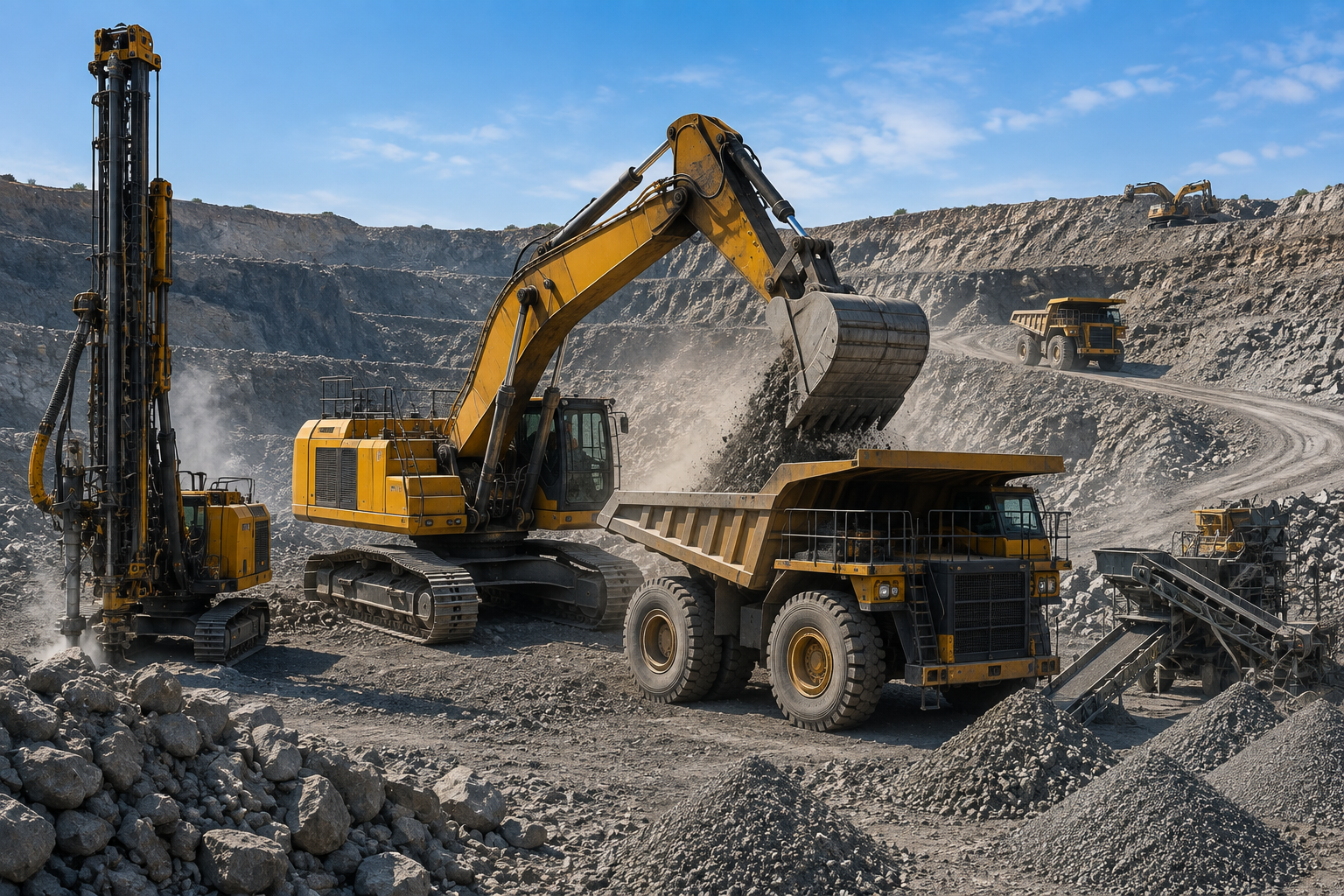
In large operations, equipment availability does not guarantee production. Trucks can lose time waiting at loading units, crushers, fuel stations or dumping points.
Komatsu’s DISPATCH Fleet Management System provides real-time visibility across loading and hauling operations and is designed to assign trucks to loading and dumping points. Its functions include truck and shovel assignment, haulage tracking and management of queuing and idle time.
A Komatsu customer case published in 2024 provides a specific example. At the operation described, frequent crusher-status changes were causing trucks to queue when the crusher was unavailable. After the dispatch process was changed, monthly truck idle time at the crusher fell from 210 hours to 38 hours. This is a customer-specific result, not a universal DISPATCH performance benchmark.
Mining and quarrying machines operate under high loads and demanding conditions, so maintenance is closely linked to equipment availability.
Komatsu’s MineCare Maintenance Management System uses machine-health data and analytics to support maintenance decisions. The current system includes real-time equipment-health monitoring and is intended to identify potential component problems and support maintenance scheduling.
Komatsu also publishes customer-case results for MineCare, including improvements in shovel availability and reductions in unplanned maintenance. Those figures are explicitly identified by Komatsu as customer case studies and are not guaranteed results for other mines.
For fleet managers, the important change is the additional information available between physical inspections and scheduled service intervals.
Quarries add a processing stage that is less prominent in conventional earthmoving.
A crushing and screening circuit can contain feeders, crushers, screens, conveyors and other process equipment. Not every plant requires the same number of crushing stages; the layout depends on the rock, feed material, required products and production target.
Metso’s current aggregate-quarry portfolio includes crushers, screens, feeders, conveyors, rock breakers and air classifiers, with mobile and portable versions available for many equipment categories.
The performance of the plant depends on how these machines operate together. Feed consistency, crusher settings, screening performance, conveying capacity and equipment condition all influence the final output and product mix.
Metso’s SiteBooster is aimed at existing stationary crushing and screening plants. The current system involves auditing the plant, identifying bottlenecks, redesigning the process or equipment and implementing an upgrade with limited disruption to production.
Autonomous haulage is no longer limited to the largest mining operations.
Komatsu’s Smart Quarry Autonomous, developed with Pronto and Komatsu dealers, is designed for open-pit quarry operations and smaller to mid-sized fleets. It can retrofit existing haul trucks with perception, positioning and control systems and supports mixed-OEM environments. Operations are monitored through a web-based interface. Komatsu states that the system is already operating in active quarry environments.
This approach is different from large mine autonomous-haulage systems that rely on dedicated control-room infrastructure. Smart Quarry Autonomous is positioned around a retrofit model for quarry-sized operations.
Caterpillar’s MineStar Command for hauling is a separate autonomous-haulage system for large mining operations.
Cat says Command-equipped trucks can operate without an onboard driver and are integrated into the wider autonomous-haulage system.
In a September 2024 update, Caterpillar reported that trucks using Command for hauling had autonomously moved more than 8.6 billion tonnes of material. That was a cumulative figure reported by Cat at the time, not material moved during 2024 alone.
The contrast with quarry automation is important: autonomy is not one machine category or one deployment model. System size, infrastructure requirements and fleet scale vary significantly between a large open-pit mine and a quarry.
Electrification is progressing alongside automation.
On June 23, 2026, BHP, Rio Tinto and Caterpillar launched a trial involving two Cat 793 XE Early Learner battery-electric haul trucks at BHP’s Jimblebar iron ore mine in Western Australia’s Pilbara. The announcement followed three months of on-site testing at the mine.
This is a field trial, not evidence that battery-electric haulage has already replaced conventional mining trucks at scale.
It also represents a different technology path from the 794 AC. The 794 AC uses diesel power with AC electric drive, while the 793 XE Early Learner trucks in the Pilbara trial are battery-electric.
The broader technology shift is about connecting individual machine activities.
Digital drilling plans can improve control of hole location and status. Payload systems measure loading performance. Fleet-management systems coordinate haulage. Machine-health platforms track equipment condition. Crushing and screening systems use process information to identify bottlenecks.
The result is a production model in which machine data can be used across more than one stage of the operation.
For a mine or quarry, that can be more useful than adding an isolated technology feature to one machine. The objective is to identify where production is being lost and use machine data to address the specific constraint.
The equipment decision is increasingly about the complete operating system rather than machine capacity alone.
A drill rig may be evaluated for hole diameter, depth and automation capability. A loading unit has to match the haul fleet. A truck’s payload needs to suit the loading unit and route. A crusher has to be matched to feed characteristics, screen capacity and the required product sizes.
Technology adds another set of selection criteria: payload monitoring, fleet integration, machine-health data, remote operation and automation capability.
The most mature applications are already commercial. Telematics, payload monitoring, machine-health systems and automated drilling functions are available today. Autonomous haulage is also operating commercially in specific mining and quarry environments, while battery-electric heavy haulage remains an area of active field development.