KEC International announced ₹2,044 crore of orders across two October disclosures, including a 765 kV pumped-storage evacuation line and 300+ MW wind project.

KEC International announced ₹2,044 crore of orders across two October disclosures, including a 765 kV pumped-storage evacuation line and 300+ MW wind project.
KEC International announced ₹2,044 crore of new orders across two separate disclosures on October 8 and October 10, 2026. The wins span Indian transmission infrastructure, a 300-plus MW wind project, overseas transmission lines and product supplies. For contractors and equipment suppliers, the important point is the order mix: high-voltage line construction and wind EPC can create demand for foundation, lifting, access and stringing packages, but KEC has not disclosed project schedules, site-level quantities or subcontracting plans.
Status check
These are confirmed new orders reported by KEC International, not an L1 declaration or a tender notice. The disclosures do not establish that site mobilisation has begun. Client names, individual contract values and execution periods were not published.
KEC’s October 10 company release reported ₹1,014 crore of new orders in its India transmission and distribution business. The package includes the company’s first order to set up a 765 kV transmission line for evacuating power from a pumped-storage plant in western India. KEC said the order came from an existing client and took its FY2026-27 year-to-date order intake above ₹9,600 crore.
Two days earlier, KEC’s October 8 release announced ₹1,030 crore of orders across three businesses:
The arithmetic total of the two announcements is ₹2,044 crore. It should not be read as a single contract. KEC did not provide a value split by project or business in the October 8 release, while the October 10 release did not list the other India T&D jobs included in its ₹1,014 crore total.
A pumped-storage plant can shift electricity between lower and upper reservoirs, storing energy when supply is abundant and generating when the grid needs it. The generating asset still needs high-capacity evacuation infrastructure. KEC’s 765 kV order connects that grid requirement to a construction package at the top end of India’s transmission-voltage range.
The win also sits within a broader build-out of renewable-energy transmission. In August, the Union Cabinet approved Green Energy Corridor Phase III, covering transmission systems linked to 13.5 GW of renewable capacity and 50 GWh of battery storage. KEC has not said that its new order forms part of that programme, so the two should not be conflated. The relevant link is the underlying need to move and balance renewable power across the grid.
Transmission-line EPC usually moves through survey and engineering, right-of-way and access preparation, foundation work, tower erection, conductor stringing, testing and commissioning. The equipment mix can therefore include excavators and augers for foundations, concrete equipment, cranes and gin-pole systems for erection, pullers and tensioners for stringing, access platforms, tractors and site vehicles. Actual fleet needs depend on terrain, tower design, foundation type, logistics and the contractor’s work method.
Wind-project construction can involve internal roads, hardstands, deep foundations, component transport and heavy lifting. However, KEC’s disclosure only identifies a “300+ MW Wind project” and does not define whether its scope includes every civil and erection package. Equipment owners should wait for package-level enquiries, location details and schedules before treating the headline capacity as a mobilisation forecast.
The overseas T&D orders also require different readings. Bhutan and Saudi Arabia are project orders, while the Americas component is described as supply of towers, hardware and poles. A product-supply order can support manufacturing and logistics without creating the same on-site equipment demand as a full EPC line package.
KEC uses the phrase “secured new orders,” which places these announcements beyond the lowest-bidder stage. That is materially different from being declared L1, where award and contract execution may still be pending. Our guide to L1 versus LoA and work-order status explains why suppliers should verify the commercial stage before committing fleet.
Even after an order is received, field activity may depend on contract signing, notices to proceed, route surveys, statutory clearances, right-of-way availability, design approvals and site handover. None of those milestones is confirmed in the two releases. KEC also did not name clients, execution deadlines, exact routes, package values, equipment quantities or subcontractors.
KEC’s year-to-date intake moved from more than ₹8,600 crore after the October 8 wins to more than ₹9,600 crore after the October 10 orders. That sequential disclosure supports the conclusion that the announcements are additive. For equipment businesses, though, the actionable opportunity begins only when individual packages, locations and mobilisation dates become visible.
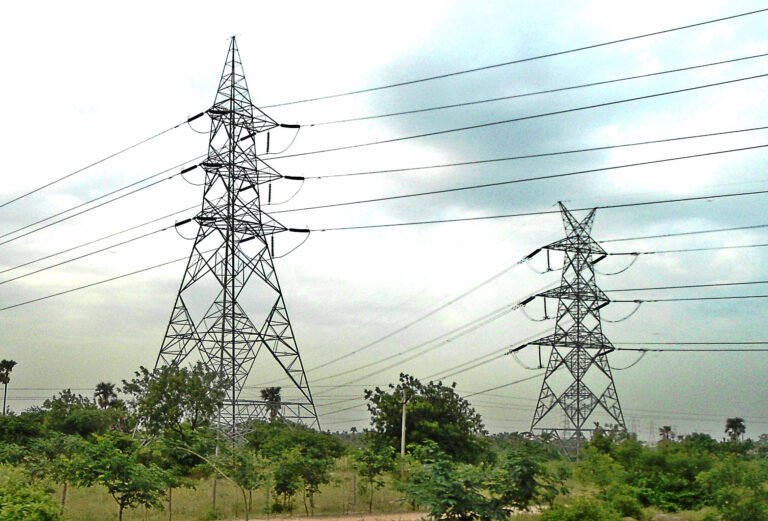
Featured image: High-voltage transmission tower in Gandhinagar, Gujarat, photographed by Abby brooklyn. Source: Wikimedia Commons, licensed under CC BY-SA 4.0. No changes made.