L&T has secured Delhi secretariat and Amaravati high-rise building orders in its ₹2,500–5,000 crore ‘Large’ band. Here is the verified scope, timeline and equipment context.

L&T has secured Delhi secretariat and Amaravati high-rise building orders in its ₹2,500–5,000 crore ‘Large’ band. Here is the verified scope, timeline and equipment context.
Larsen & Toubro (L&T) has announced two new building orders in India, covering the Common Central Secretariat in New Delhi and a pair of high-rise office towers in Amaravati. The company classifies the announcement as “Large”, its internal band for orders valued between ₹2,500 crore and ₹5,000 crore. L&T has not disclosed a separate value for either contract or said whether the band represents an exact combined amount.
The orders matter to contractors and equipment suppliers because they combine two different construction profiles: a 32.8-lakh-sq-ft government complex with a five-year operations and maintenance obligation, and 47-storey towers requiring high-rise concrete, lifting, pumping and logistics planning. However, an order announcement is not evidence that full site mobilisation has begun.
| Project | Client | Delivery model and scope | Scale | Stated timeline |
|---|---|---|---|---|
| Common Central Secretariat buildings 4 and 5, New Delhi | Central Public Works Department | EPC; structural, architectural, MEP and external development works | Two basement + ground + 7-floor buildings; 32.8 lakh sq ft total built-up area | 24 months, followed by five years of O&M |
| Office towers beside the Amaravati Quantum Computing Centre | Government of Andhra Pradesh | Design and build; shell-and-core works | Two basement + ground + 47-floor towers; 37.5 lakh sq ft combined built-up area | 30 months |
These details come from L&T’s official 21 October 2026 release. The disclosure confirms receipt of orders, but it does not publish package-wise prices, notice-to-proceed dates, construction start dates or subcontracting packages.
The Central Public Works Department has awarded L&T the engineering, procurement and construction package for Common Central Secretariat buildings 4 and 5 along Kartavya Path. L&T’s stated scope covers structural and architectural works, mechanical, electrical and plumbing systems, and external development.
For the supply chain, that mix points to a longer equipment sequence than the headline “building order” may suggest. Early activity can include survey and setting-out, excavation, shoring, dewatering and foundation works. The structural phase typically brings tower cranes or other lifting systems, concrete pumps, batching and placement equipment, formwork systems, material hoists and temporary power. MEP installation and external development create later demand for access equipment, smaller lifting machines, compactors and utility-work equipment.
The five-year O&M period is also significant. It extends L&T’s responsibility beyond construction completion, although the release does not detail the assets, service levels or facility-management packages covered by that obligation.
The Amaravati order is for two office towers on either side of the Amaravati Quantum Computing Centre. Each proposed tower has a basement, ground floor and 47 upper floors. Together, they account for 37.5 lakh sq ft of built-up area.
L&T describes the contract as design-and-build and limits its announced scope to shell-and-core works. That wording is important: the release does not state that L&T has the complete interior fit-out or every specialist system package.
High-rise shell-and-core execution places particular emphasis on vertical logistics. Contractors and vendors should expect procurement decisions to focus on crane reach and tie-in planning, concrete pumping height, repetitive formwork cycles, rebar handling, worker and material hoists, backup power, wind limits and preventive maintenance. Those are practical demand indicators, not confirmed purchase orders for any named machine or supplier.
L&T’s disclosure uses a value classification instead of a precise rupee figure. Under the company’s published bands, “Large” covers ₹2,500 crore to ₹5,000 crore. Equipment Brief is therefore not assigning an exact ₹5,000-crore value to the two projects, and suppliers should not use the upper end of the range as a confirmed award amount.
The filing also should not be confused with an L1 declaration or a letter of intent. L&T says it has secured the orders, which is a firmer procurement stage than simply emerging as the lowest bidder. Even so, receipt of an order does not prove that a notice to proceed has been issued, sites have been handed over, labour camps are operating or equipment has mobilised.
For a fuller procurement-stage checklist, see Equipment Brief’s guide to L1, LoA and work-order terminology. The distinction is also visible in the earlier L&T Tashkent airport pre-construction update, where full site work remained subject to a notice to proceed.
The next useful signals are project-specific start notices, site-handover confirmation, major subcontract awards and equipment mobilisation. Until those emerge, the defensible conclusion is that L&T has secured two substantial building orders with disclosed scopes and delivery periods—not that every downstream package has been awarded or that construction is fully underway.
For broader market context, Equipment Brief’s review of Indian contractor order books and FY27 execution explains why order intake and actual revenue-generating execution should be tracked separately.
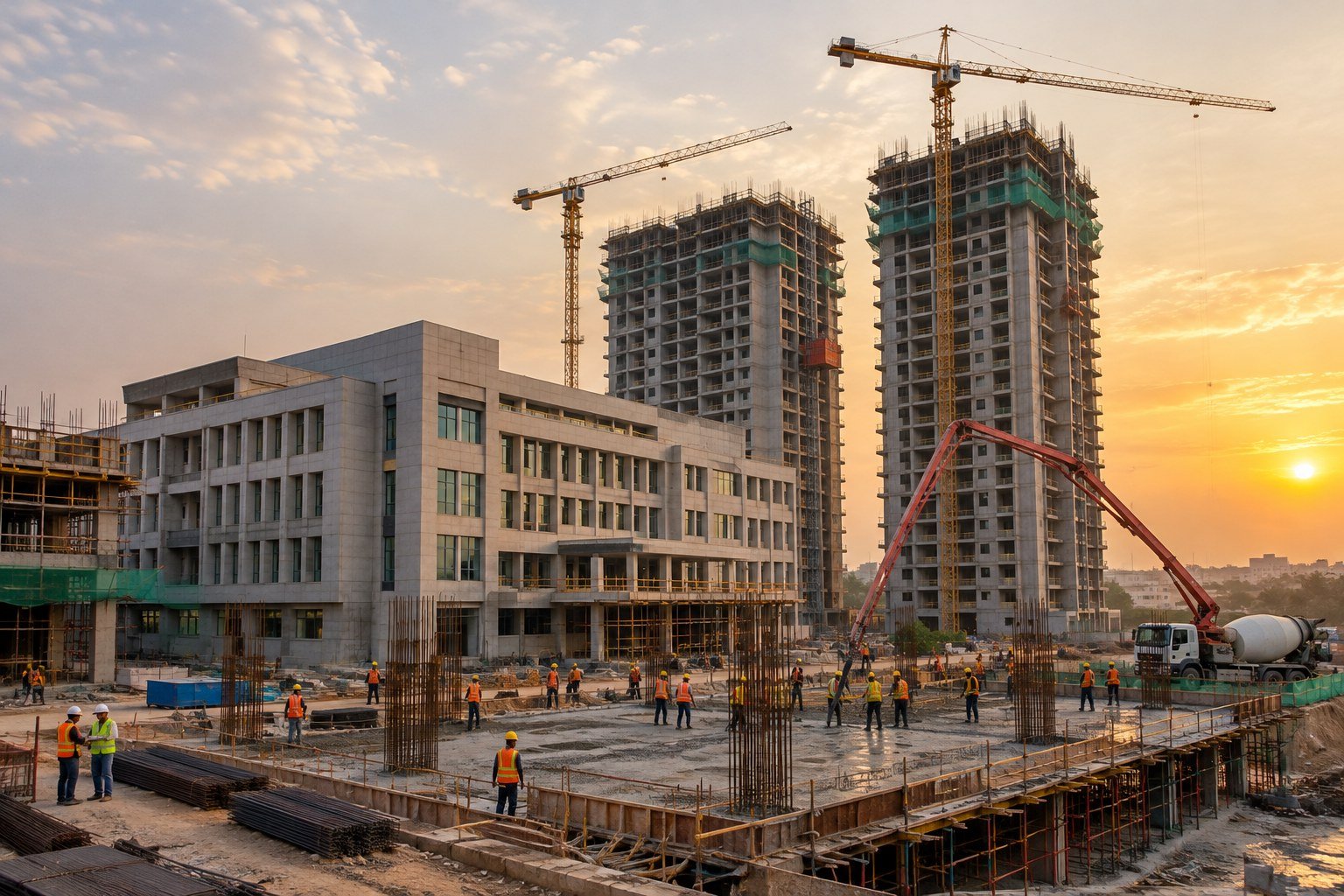
Featured image: AI-generated illustrative newsroom artwork created for Equipment Brief. It does not depict either project’s final design or current construction status.