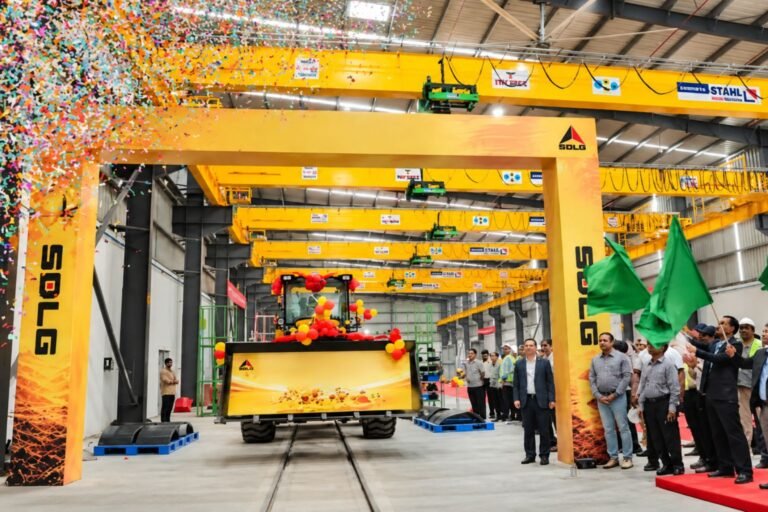
India’s infrastructure expansion is driving strong demand for construction equipment, with new projects and changing machine technologies reshaping the industry.


India’s infrastructure expansion is driving strong demand for construction equipment, with new projects and changing machine technologies reshaping the industry.
India’s infrastructure programme continues to generate demand for construction equipment, but the equipment market is being shaped as much by project execution, regulation and technology as by government spending.
The Union Budget 2026-27 proposes ₹12.2 lakh crore of public capital expenditure, compared with ₹11.2 lakh crore in the 2025-26 Budget Estimate. Effective capital expenditure, including grants for creation of capital assets, is budgeted at ₹17.15 lakh crore.
That investment has not translated into uninterrupted equipment-sales growth. According to ICEMA data reported for FY2025-26, total construction-equipment sales fell about 2% to 136,995 units, from 140,191 units in FY2024-25. Domestic demand fell about 7%, while exports increased 31.5% to 17,394 units.
The numbers point to a market where project execution, machine productivity and operating economics are becoming increasingly important.
Earthmoving equipment continues to account for the largest share of India’s construction-equipment market.
ICEMA recorded 99,159 earthmoving machines sold in FY2025, representing 71% of total equipment sales. Backhoe loaders accounted for 53,133 units, while crawler excavators accounted for 35,816 units.
The figures show the continuing importance of machines that can handle excavation, loading and general civil work across a wide range of projects.
Backhoe loaders remain a high-volume category, while crawler excavators serve larger earthmoving and infrastructure applications. The underlying requirement is not simply more equipment, but equipment that can deliver sufficient utilisation at an acceptable operating cost.
Highway construction remains an important equipment market.
The Ministry of Road Transport and Highways reported 12,349 km of National Highways constructed in 2023-24. Construction reached 33.8 km per day, compared with 12.1 km per day in 2014-15. The ministry also recorded 9,642 km of lane augmentation and 5,193 km of four-lane-and-above roads, including expressways and access-controlled highways, during the same year.
At the same time, highway agencies are testing more automated construction methods.
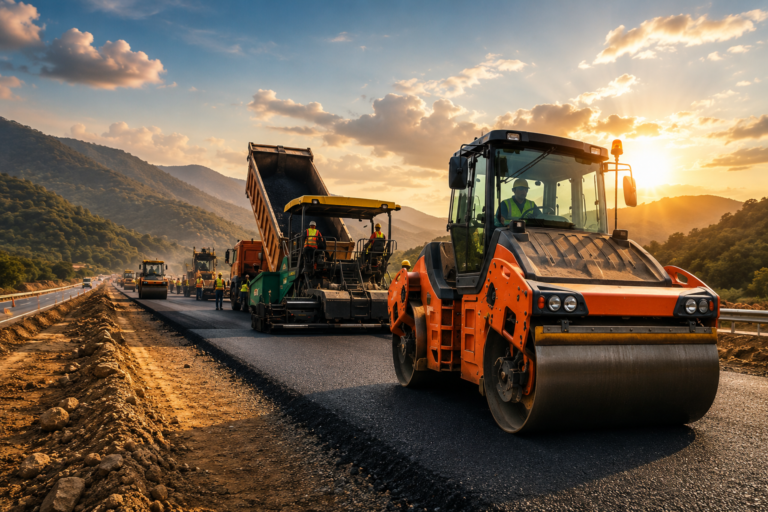
MoRTH’s framework for Automated & Intelligent Machine-aided Construction (AIMC) includes GPS-aided motor graders, intelligent compaction rollers and stringless pavers. A pilot project on the Lucknow-Kanpur Expressway used a GPS-aided motor grader, intelligent compactor and stringless paver. MoRTH said the approach was being introduced on a pilot basis for selected expressways and access-controlled National Highway projects.
NHAI’s March 2026 publication also highlighted AIMC, drone analytics, mobile quality-control vans and network survey vehicles as examples of technology being used in National Highway construction and maintenance.
For contractors, this changes the role of the machine. Graders, rollers and pavers are increasingly part of a connected construction process involving positioning, digital information and quality control.
Connected machines are moving further into day-to-day fleet management.
JCB says its LiveLink telematics platform provides information on machine location, utilisation, fuel consumption, maintenance requirements and security. In August 2026, the company announced that LiveLink would become standard on its mini excavators and site dumpers, with a five-year subscription included. JCB says the platform currently connects more than 580,000 machines worldwide and supports more than 40,000 customers.
For fleet operators, the practical value lies in monitoring machines across multiple sites, identifying maintenance requirements and improving visibility of utilisation.
That matters as contractors manage equipment over longer distances and across increasingly dispersed project portfolios. The technology is useful when it provides information that can feed directly into maintenance and fleet decisions.
Electric construction equipment is entering more applications, although adoption depends heavily on operating conditions and site infrastructure.
JCB’s 19C-1E electric mini excavator is designed with zero emissions at the point of use. JCB positions the machine for applications where low noise and the absence of exhaust emissions are useful.
The wider shift involves more than replacing an engine with a battery.
In May 2026, Volvo Construction Equipment and Hitachi Energy signed a memorandum of understanding covering power supply, charging, energy management and operational integration for zero-emission construction sites. The companies said the work would examine system-level requirements for deploying electric construction equipment together with the required power and energy infrastructure.
For India, the practical constraints are clear: machine duty cycles, available electrical capacity, charging arrangements and site layout all affect whether an electric machine can deliver the required productivity.
The transition to stricter construction-equipment emissions standards has affected both machine design and cost.
Industry reporting based on ICEMA’s FY2025-26 data said higher equipment prices following the move to CEV Stage V were one factor affecting domestic demand. The same transition was identified as a factor supporting stronger export opportunities for Indian-manufactured equipment.
Regulation is also extending beyond emissions.
The Ministry of Heavy Industries’ Machinery and Electrical Equipment Safety (Omnibus Technical Regulation) Amendment Order, 2025 states that the regulation applies from 1 September 2026 to machines and electrical equipment listed in its First Schedule. The order specifically exempts construction equipment covered by the Central Motor Vehicles Rules, 1989.
For manufacturers, such changes affect compliance, certification and product development. For buyers, regulatory requirements are becoming another factor in equipment selection.
India’s construction-equipment rental market remains less mature than those in several established markets.
An ICEMA publication put equipment-rental penetration in India at 20–22%, compared with about 50% globally. It identified financing pressures, equipment costs and the entry of larger organised rental companies as factors supporting further growth.
Rental can reduce the capital required to add equipment for individual projects and can help contractors manage periods of uneven machine utilisation.
For fleet managers, the calculation is therefore moving beyond the purchase price. Expected hours of use, maintenance, finance costs and the ability to redeploy a machine between projects can all influence whether ownership or rental makes more sense.
India’s equipment industry is also strengthening its position as an export base.
ICEMA reported 13,230 construction-equipment exports in FY2025, up from 11,990 in FY2024. It also reported that 98% of construction equipment sold domestically in FY2025 was manufactured in India.
In FY2026, exports increased further to 17,394 units, a 31.5% year-on-year rise, even as total industry sales declined. Industry reporting linked the export increase partly to India’s transition to CEV Stage V emissions standards and the resulting alignment with international markets.
For Indian OEMs and component suppliers, export growth raises the importance of product compliance, manufacturing quality and international service capability.
The market is still centred on conventional earthmoving machinery, but the buying decision is becoming broader.
For contractors and equipment owners, the important questions increasingly include:
How intensively will the machine be used? Utilisation has a direct effect on ownership economics.
What data does the machine provide? Telematics can support maintenance and fleet decisions when the information is actionable.
What does the project require? Road projects using machine-control systems, for example, create different equipment requirements from conventional earthmoving work.
How will regulations affect the machine’s operating life? Emissions and safety requirements need to be considered alongside price and specification.
Does the project favour ownership or rental? For uneven utilisation, rental can reduce the capital commitment.
India’s infrastructure investment provides the underlying demand, but equipment manufacturers and users are dealing with a market that is becoming more focused on productivity, operating cost, compliance and machine data.
The next phase of construction-equipment growth will depend not only on how much infrastructure India builds, but also on how efficiently that work is executed and how quickly equipment technology adapts to it..