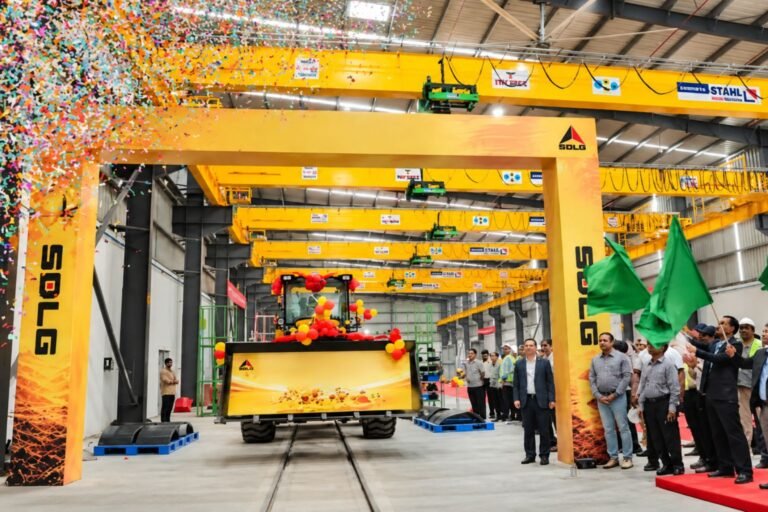
India’s heavy equipment market is being shaped by infrastructure investment, construction activity, equipment demand and changing industry trends.


India’s heavy equipment market is being shaped by infrastructure investment, construction activity, equipment demand and changing industry trends.
India’s construction-equipment market enters FY2026-27 with a large public infrastructure programme behind it, but recent industry figures show that spending alone does not determine equipment demand.
The Union Budget 2026-27 proposes ₹12.2 lakh crore of public capital expenditure, compared with ₹11.2 lakh crore in the 2025-26 Budget Estimate. Effective capital expenditure is budgeted at ₹17.15 lakh crore. (pib.gov.in)
At the same time, construction-equipment sales fell in FY2025-26. ICEMA data shows total sales of 136,995 units, down about 2% from 140,191 units in FY2024-25. Domestic demand declined by about 7%, while exports increased 31.5% to 17,394 units. (business-standard.com)
The result is a market with strong long-term infrastructure support but a more uneven short-term demand picture. Project execution, equipment costs, emissions compliance, localisation and exports are becoming important alongside the infrastructure pipeline.
The scale of government capital spending provides the underlying demand base for construction equipment.
Public capital expenditure has risen from about ₹2 lakh crore in FY2014-15 to ₹12.2 lakh crore proposed for FY2026-27. The Budget also includes an Infrastructure Risk Guarantee Fund aimed at supporting private-sector infrastructure development. (pib.gov.in)
For equipment manufacturers, the important question is how quickly this spending converts into active projects.
ICEMA’s FY2026 assessment, reported by industry publications, linked the decline in domestic equipment demand to slower infrastructure execution and project delays. Higher equipment prices following the transition to CEV Stage V and financing pressures also affected the market. (business-standard.com)
For OEMs and dealers, project mobilisation remains a better indicator of near-term machine demand than budget allocation alone.
Earthmoving remains the largest segment of India’s construction-equipment market.
ICEMA recorded 99,159 earthmoving units in FY2025, representing about 71% of total equipment sales. Backhoe loaders accounted for 53,133 units, while crawler excavators contributed 35,816 units. (i-cema.in)
FY2026 retained the same broad structure. Earthmoving accounted for about 71% of total sales, although the segment declined along with the wider domestic market. (timesofindia.indiatimes.com)
Backhoe loaders and excavators serve a wide range of civil and infrastructure applications, which helps explain their position in the market. For buyers, however, the relevant comparison is often utilisation and operating cost rather than the headline sales volume of a category.
Road construction has been one of the stronger equipment segments in the recent market data.
ICEMA’s FY2026 figures show 7,445 road-construction equipment units sold, up 6.3% year on year. Material-processing equipment sales rose 1.2%, while material-handling equipment declined 10%. (timesofindia.indiatimes.com)
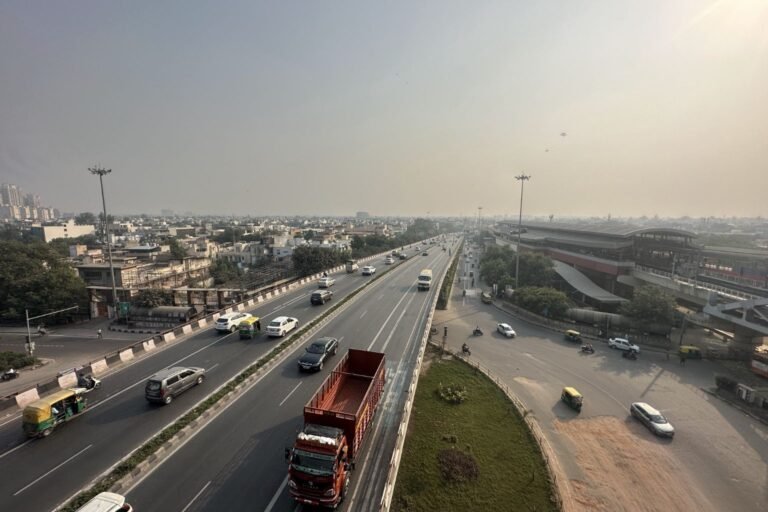
The broader highway programme remains significant. MoRTH reported 12,349 km of National Highways constructed in 2023-24, with construction reaching 33.8 km per day. (morth.gov.in)
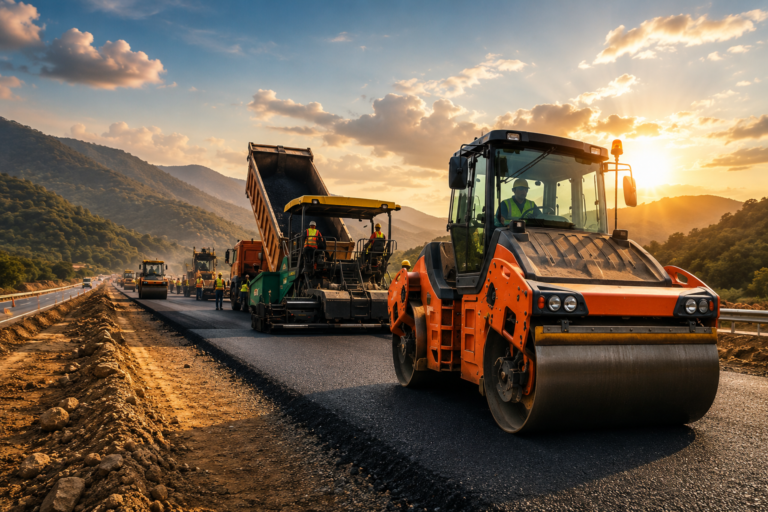
Road projects generate demand across several equipment types, including excavators, graders, asphalt plants, pavers and compactors. They also provide a testing ground for greater use of machine-control and digital construction systems.
MoRTH’s Automated & Intelligent Machine-aided Construction (AIMC) framework covers technologies including GPS-aided motor graders, intelligent compaction rollers and stringless pavers. Its technical requirements use RTK-based positioning to improve machine-location accuracy. (morth.nic.in)
NHAI has also identified AIMC alongside drone analytics and management systems, mobile quality-control vans and network survey vehicles in its highway-construction and maintenance technology initiatives. (nhai.gov.in)
For equipment buyers, this can change procurement requirements. On projects where digital machine control is specified, positioning systems and compatibility with project data may become part of the machine specification.
Connected equipment is increasingly being used to monitor machines after they leave the dealer yard.
JCB’s LiveLink platform provides machine-location, utilisation, fuel-consumption, maintenance and security information. JCB says more than 580,000 machines worldwide are connected to the platform. (jcb.com)
Tata Hitachi’s ConSite and InSite systems provide machine-health, operating and location information. The company’s current system includes functions such as maintenance alerts, performance analysis, fuel-level monitoring, geofencing and asset-utilisation data. (tatahitachi.co.in)
The practical use is fleet visibility. Contractors can monitor machines working across multiple sites and use operating data to support maintenance and utilisation decisions.
The transition to stricter construction-equipment emissions standards has increased the technical requirements and cost of new equipment.
Industry reporting on ICEMA’s FY2026 results identified higher equipment prices after the transition to CEV Stage V as one factor affecting domestic demand. The move has also helped Indian manufacturers align products more closely with requirements in export markets. (business-standard.com)
For buyers, emissions compliance is part of the total ownership equation. Engine technology, after-treatment requirements, maintenance and operating conditions all influence the cost of running a machine.
India’s equipment industry has a substantial domestic manufacturing base.
ICEMA reported that 98% of construction equipment sold domestically in FY2025 was produced in India. (i-cema.in)
The association also reports average localisation of around 60%, with localisation above 90% for some products. At the same time, India still imports certain critical components, including hydraulic systems, undercarriage components, electrical and electronic parts and telematics systems. (i-cema.in)
The equipment industry therefore has two parallel priorities: increase local content while strengthening domestic supply for components that remain import-dependent.
Exports were one of the strongest parts of the Indian equipment market in FY2026.
ICEMA recorded 17,394 exported units, up 31.5% from the previous year. This came while overall industry sales declined and domestic sales fell. (business-standard.com)
The previous year had already recorded growth. ICEMA reported 13,230 exports in FY2025, compared with 11,990 in FY2024. (i-cema.in)
The shift matters for Indian manufacturers because export markets provide another source of demand when domestic project execution slows. It also raises the importance of meeting international requirements for emissions, quality and product support.
Equipment rental is growing, but penetration remains below levels seen in mature markets.
An ICEMA publication estimated construction-equipment rental penetration in India at 20–22%, compared with about 50% globally. The association identified financing pressures, equipment costs and the entry of larger organised rental companies as factors supporting further development of the rental sector. (i-cema.in)
For contractors, rental can provide additional equipment capacity without the capital commitment associated with outright ownership.
The economics depend on utilisation. High-use machines that can move between projects may justify ownership, while short-duration or uncertain requirements can make rental more practical.
Electric construction equipment remains an emerging segment rather than a replacement for the diesel fleet.
JCB’s 440 Electric Wheel Loader is one example of an electric machine being offered in India. JCB identifies zero tailpipe emissions and quieter operation among the machine’s characteristics. (jcb.com)
The wider challenge is infrastructure.
In May 2026, Volvo Construction Equipment and Hitachi Energy signed a memorandum of understanding covering power supply, charging solutions, energy management and operational integration for zero-emission construction sites. (volvoce.com)
For contractors, the decision is therefore not limited to the machine. Duty cycle, charging time, electrical capacity and site arrangements also determine whether an electric machine fits the application.
India’s heavy-equipment market is being pulled by several forces at once.
Infrastructure investment provides the demand base, with public capex reaching ₹12.2 lakh crore in the FY2026-27 Budget. (pib.gov.in)
Earthmoving remains the dominant equipment segment, while road-construction equipment has shown stronger recent growth. Digital systems are moving into machine control, telematics and fleet management. CEV Stage V is affecting equipment economics, while localisation and export growth are strengthening India’s manufacturing position.
For contractors and fleet owners, the purchasing decision increasingly centres on utilisation, uptime, operating cost, compliance and service support.
The market is not simply growing because India is spending more on infrastructure. It is changing because the equipment used to deliver that infrastructure is becoming more connected, more regulated and increasingly integrated with the wider construction process.