JCB India’s plan to double annual manufacturing capacity to approximately 170,000 machines by 2030 points to a broader strategy spanning localisation, exports, product diversification and India’s role in JCB’s global manufacturing network.

JCB India’s plan to double annual manufacturing capacity to approximately 170,000 machines by 2030 points to a broader strategy spanning localisation, exports, product diversification and India’s role in JCB’s global manufacturing network.
JCB India is preparing a major expansion of its manufacturing capacity — and the plan says as much about India’s changing role in JCB’s global business as it does about the domestic market.
The company’s Managing Director and CEO, Deepak Shetty, said JCB intends to raise annual manufacturing capacity in India from around 85,000 machines to approximately 170,000 by 2030. The figure was reported by Financial Express, with Mint separately reporting that JCB’s current capacity is about 85,000 machines annually and is expected to double by 2030.
Equipment Brief analysis: a target of this scale is not simply a response to domestic demand. JCB’s public statements, as reported by the two publications, place Indian manufacturing increasingly inside the company’s global supply chain, with India supplying machines as well as engines, transmissions, components and steel fabrications to overseas JCB operations.
Three things are happening at once, according to public statements from Shetty: capacity is expanding, localisation is deepening, and the product portfolio is broadening.
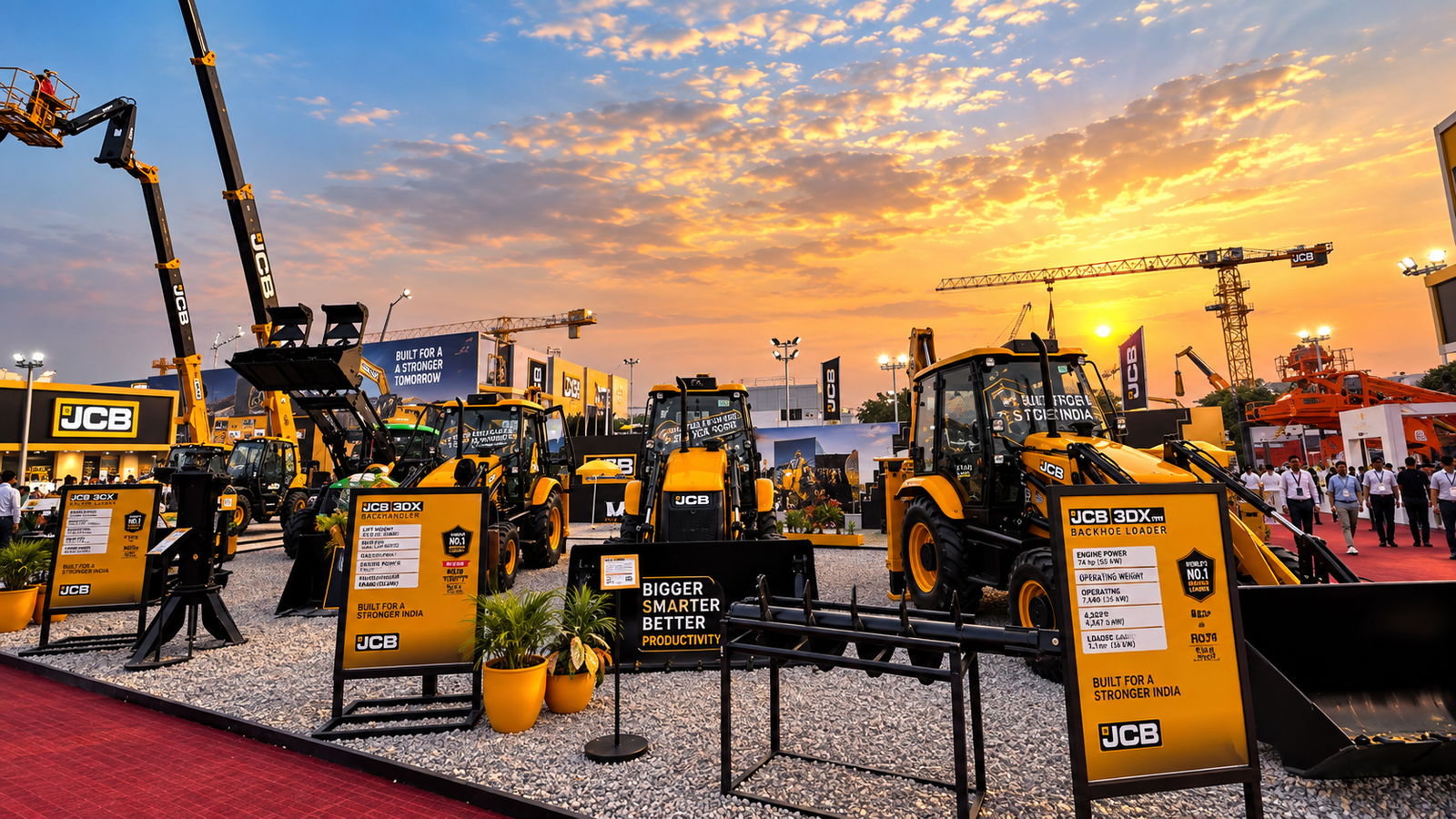
At bauma CONEXPO INDIA 2026, JCB unveiled 10 new machines within a wider display of 21 machines, according to Fortune India. JCB’s official bauma CONEXPO INDIA event page also shows a portfolio spanning backhoe loaders, excavators, compactors, telehandlers, access equipment and generators. Equipment Brief’s detailed report on the 10-machine launch covers the product line-up separately.
Equipment Brief analysis: a broader product base gives a manufacturing footprint more ways to stay utilised across different demand cycles. Capacity alone has limited value if it is tied to one narrow application; JCB’s expansion is arriving alongside, not instead of, a wider portfolio.
Shetty has stated that JCB’s backhoe loaders are approximately 96% localised, while excavators are in the 65–75% range. These figures were reported by both Financial Express and Mint.
Equipment Brief analysis: the gap between the two product lines is the more useful business signal than the headline localisation number. The backhoe-loader figure reflects a deeply established Indian supply base, while the lower excavator figure indicates that this product line still has materially lower local sourcing. That leaves greater exposure to imported components and associated supply-chain variables. Financial Express reported that JCB is using greater localisation to reduce exposure to imported components and logistics costs.
JCB has also signalled an export push tied to the wider expansion. Financial Express reported that JCB exported around 14,000 machines in the previous year and is targeting 15–20% export growth in the current financial year. Fortune India separately reported that the company plans to raise production to approximately 70,000 units in FY27 and is targeting 15–20% export growth.
Equipment Brief analysis: these should be read as distinct measures, not as one projection. The approximately 70,000-unit figure is a near-term production target, while 170,000 machines is the longer-term annual manufacturing-capacity target for 2030. The former describes planned production in the current financial year; the latter describes the capacity JCB intends to build. Neither establishes that 170,000 machines will actually be produced.
JCB is also working with the Railway Ministry to adapt existing machine platforms for railway-related applications. Financial Express and Mint both report that the company is engineering attachments and modifications that can allow machines such as backhoe loaders to work across conventional construction and railway applications rather than requiring an entirely new machine category for every use case.
Equipment Brief analysis: this could allow JCB to address additional applications using existing machine platforms rather than developing a wholly new product for every use case. The actual commercial scale of the railway initiative has not been disclosed, so its contribution to future machine volumes cannot yet be estimated.
JCB has said it uses Internet of Things technology to monitor about 300,000 machines, with data covering machine health, fuel consumption and operator performance. That figure comes from Mint.
Shetty also told Mint and Financial Express that JCB invests approximately ₹200–500 crore annually across research and development and capacity expansion. Mint also reported that the company introduces 10–12 new products a year.
Equipment Brief analysis: taken together with the capacity and localisation plans, this points to a strategy built on three connected layers — manufacturing scale, product breadth, and connected-machine data — rather than capacity as a standalone lever. Whether this combination changes the underlying economics for JCB or its customers depends on adoption and utilisation, which current public data does not allow us to quantify.
A plan to double capacity is a large commitment, but capacity alone does not guarantee sales. The more consequential question is whether JCB can convert that additional capacity into sustained, commercially viable production across a domestic market subject to infrastructure-spending cycles and an export market exposed to global demand, trade conditions and logistics.
Equipment Brief analysis: this is where the four pillars connect. Deeper localisation can reduce import and logistics exposure as production scales. A broader product range and cross-application flexibility can reduce dependence on any single demand segment. Export growth can diversify revenue away from India’s domestic infrastructure cycle alone. None of these elements independently establishes that a 170,000-machine capacity will be fully utilised. Together, however, they describe the operating model JCB is putting around the expansion.
Excavator localisation. Whether the 65–75% range moves materially closer to the 96% backhoe-loader benchmark will indicate how quickly JCB is deepening the supply base for excavators.
Export execution. Whether the stated 15–20% export-growth target is achieved and sustained beyond a single financial year will show how much of the expanded Indian manufacturing footprint is being absorbed by overseas demand.
Application diversification. Whether the railway-adaptation initiative and other non-core applications move from development into measurable commercial deployment will indicate whether existing machine platforms can open additional demand channels.
Capacity utilisation. Whether installed-capacity growth is matched by actual production growth will be one of the clearest tests of the strategy. The gap between the two is where announced capacity plans can diverge from realised volumes.
For now, the concrete fact is the target itself: JCB is planning to double its Indian manufacturing capacity to approximately 170,000 machines by 2030. The broader significance is the role India is being positioned to play within that strategy — not only as a major market, but increasingly as a manufacturing, engineering and export base within JCB’s global network. This strategy also sits within the wider shift toward lower-emission equipment; Equipment Brief’s CEV Stage V analysis examines that regulatory transition. Whether the broader shift fully materialises will depend on execution over the next several years.