Piling equipment is not a single machine category. The required rig and tooling depend on the foundation method, drilling diameter and depth, soil conditions and the way the pile is constructed.

Piling equipment is not a single machine category. The required rig and tooling depend on the foundation method, drilling diameter and depth, soil conditions and the way the pile is constructed.
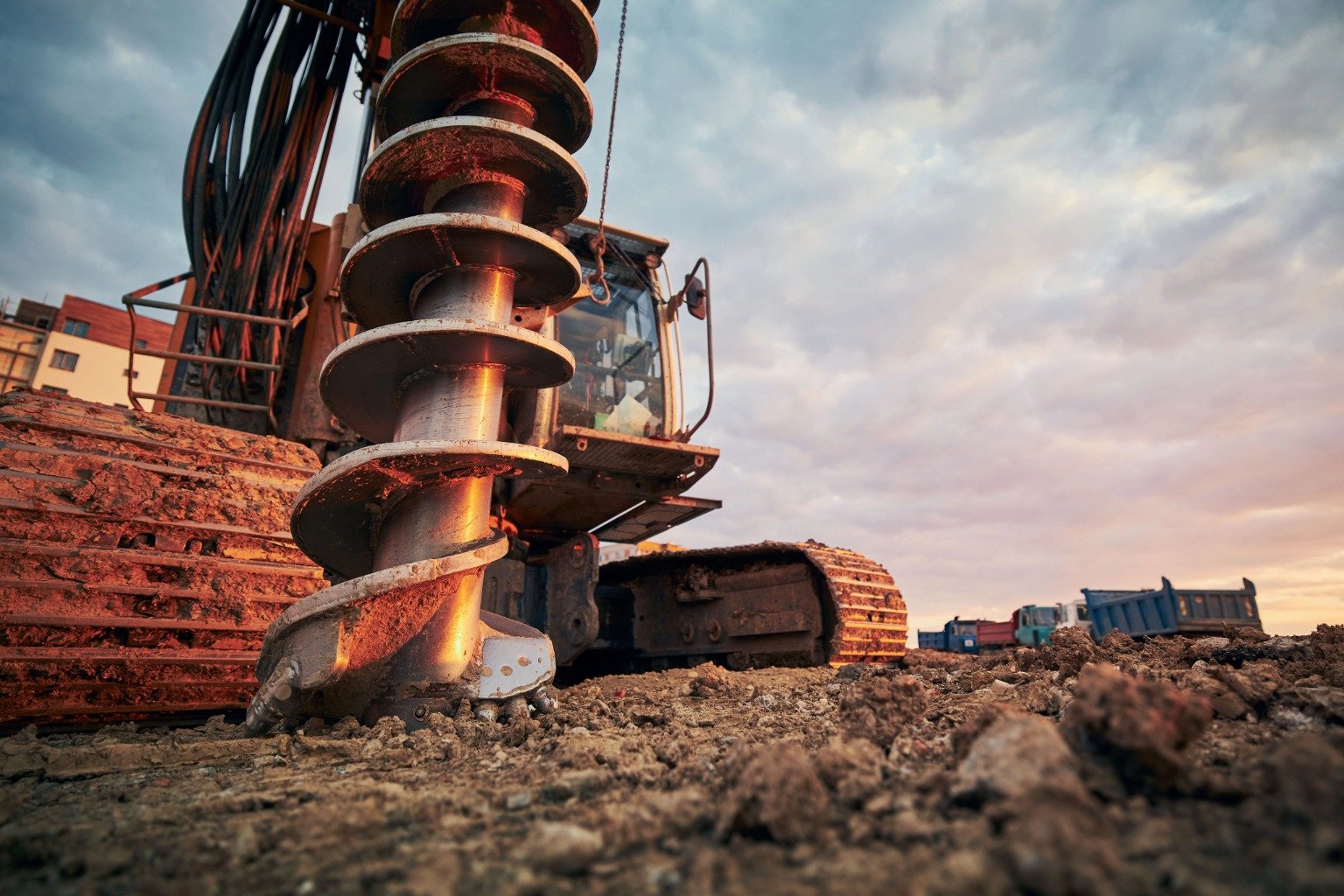
The main technologies covered by major foundation-equipment manufacturers include Kelly drilling, continuous flight auger (CFA), cased augered piles, displacement piling and soil improvement. Diaphragm-wall construction uses different equipment again, including grabs and trench cutters.
The distinction matters on infrastructure and building projects because a rig configured for one method may require different tooling or attachments for another.
Kelly drilling is a conventional bored-pile method in which a drilling tool is mounted on a telescopic Kelly bar.
BAUER says its Kelly drilling method can be used in all soil types, including rock. The company lists drilling diameters from 600 mm to 3,000 mm and maximum drilling depths of 125 m, depending on the equipment and application.
BAUER’s KellyLine range is designed specifically for Kelly drilling. The current range includes machines such as the BG 28 BT 70, BG 30 BT 80, BG 36 BT 90 and BG 42 BT 110. The BG 42 BT 110 is listed with 420 kNm maximum torque and 405 kW maximum engine power.
A typical bored-pile operation can involve casing or drilling fluids when bore stability requires additional support. The exact arrangement depends on the ground conditions and the construction method selected.
Continuous Flight Auger, or CFA, works differently from conventional Kelly drilling.
A continuous-flight auger is built around a hollow central stem. The auger advances into the ground while the excavated material is carried upward along the flights. At the required depth, concrete is pumped through the hollow stem while the auger is withdrawn. A reinforcement cage can then be installed into the fresh concrete.
Soilmec currently specifies CFA applications for pile diameters of 400 to 1,400 mm and depths of 15 to 33 m, depending on soil and pile diameter. The company lists the method for cohesive and cohesionless soils and says it can be used without bentonite fluid as wall support.
BAUER’s current foundation-engineering information gives a different operating envelope for its CFA systems: diameters from 600 to 1,200 mm and maximum drilling depths of 50 m. The company says the bore is stabilised by the soil around the auger and that concrete is pumped through the hollow stem during extraction.
The different ranges published by manufacturers illustrate why CFA capability cannot be treated as a universal rig specification. The actual limits depend on the machine, tooling and ground conditions.
CFA has also received specific attention from India’s geotechnical sector.
The DFI of India Continuous Flight Auger Pile Technology Implementation Committee was formed in 2018 to introduce and promote CFA piling for India’s fast-track foundation requirements. DFI India says a demonstration programme involving pile installation and testing was successfully conducted between 2018 and 2019 using Indian labour and materials. The committee subsequently prepared guidance covering CFA pile design, installation and testing.
That work provides a useful reference point for understanding where CFA sits in India’s foundation-equipment landscape.
Displacement piling uses a different principle from conventional bored piles.
Instead of excavating a bore and removing most of the soil, the process displaces or compacts the surrounding ground as the pile is formed.
Casagrande’s current piling-rig range includes machines configured for displacement piles alongside bored piling, CFA and other foundation methods. Its product range includes the CB16 and CB20, the B-series XP-2 machines, C-series rigs and multifunctional CV-series equipment.
Soilmec also lists DP, or displacement piles, among the technologies that can be performed with its Advanced series rigs.
The choice between displacement and bored-pile methods depends on the design and ground conditions. They are different construction processes and should not be treated as interchangeable simply because a rig can be configured for both.
Some foundation rigs are designed to switch between several methods.
Soilmec’s SR-45 and SR-75 Advanced series can be configured for LDP, CFA, CAP/CSP, LHR, DP, DTH and TJ technologies. Soilmec describes the machines as multi-technology platforms intended to adapt to different soil conditions and foundation requirements.
Its larger SR-135 supports:
cased and uncased bored piles
CFA piles
cased augered piles
displacement piles
Turbojet and Twin Shaft Turbojet soil-consolidation applications
The SR-135 is equipped with Soilmec’s Drilling Mate System (DMS) on a 12-inch touchscreen for monitoring and control of rig performance and operating parameters.
BAUER takes a similar multifunctional approach. Its drilling-rig range includes H- and V-kinematics machines as well as a dedicated KellyLine. The company also offers drilling tools, casings, casing oscillators and other accessories for different foundation methods.
The advantage of a multi-technology machine is flexibility. Contractors can configure the same base machine for different foundation systems, although the required tooling and equipment package changes with the application.
Deep foundations do not always rely on individual piles.
A diaphragm wall is constructed as a series of rectangular panels that are joined to form a continuous underground wall. BAUER identifies diaphragm walls as being used for applications including retaining structures, cut-off walls and structural foundation elements.
The excavation equipment can be a trench cutter or diaphragm-wall grab. BAUER says the selection depends primarily on soil conditions and trench depth. During excavation, the open trench is supported with slurry to help prevent groundwater intrusion and collapse of the soil.
Casagrande also maintains a dedicated diaphragm-wall equipment range alongside its piling rigs. Its current product catalogue includes the KHD B200, B250, B300 and B360, as well as KRC equipment and hydraulic grabs.
This is a separate equipment discipline from rotary piling, even though some foundation contractors operate across both.
A piling rig’s torque, drilling diameter, depth capability, engine power and crowd or extraction forces determine the work it can perform.
Casagrande’s CB16, for example, is specified with:
169 kNm maximum torque
209 kW engine power
1,800 mm maximum drilling diameter
57 m maximum drilling depth
44-tonne operating weight
The CB16 is also configured for rotary drilling, LDP, casing handling, CFA, CFA Rapid, displacement piles and soil mixing.
At the larger end of Casagrande’s current range, the B360 XP-2 is listed at 400 kNm maximum torque, 472 kW engine power and 123 tonnes operating weight. The manufacturer lists it within its XP-2 piling-rig range.
BAUER’s V-kinematics range illustrates another approach to larger drilling requirements. Its BG 45 BS 95 is listed with 461 kNm maximum torque, up to 100 m Kelly drilling depth and a maximum uncased Kelly drilling diameter of 3,700 mm.
These specifications show why machine selection starts with the pile design and ground investigation, not with a generic classification such as “large piling rig.”
Modern drilling rigs increasingly include systems to monitor and control operating parameters.
Casagrande’s current C20 piling rig includes a display for drilling depth, mast verticality and engine parameters. The machine also offers drilling-depth measurement and automatic mast-verticality control, with FleetMaster available for remote rig monitoring and control.
Soilmec’s DMS performs a similar role on the SR-135, providing monitoring and control of rig performance and operating parameters through a touchscreen interface.
BAUER’s drilling rigs use B-Tronic electronic control and assistance systems. The company’s current drilling-rig range also includes support systems designed around operator assistance and monitoring.
For foundation contractors, the value of these systems is the information generated during drilling. Depth, machine position and operating parameters can be monitored rather than relying only on manual records.
Piling productivity depends on the equipment working around the rig as well.
DFI India’s CFA guidance identifies supporting equipment including a concrete or grout pump, excavator, auxiliary crane for reinforcement cages and monitoring equipment.
The same principle applies to bored piling. Casing systems, drilling tools and other attachments may be required depending on the method and ground conditions. BAUER’s equipment range includes drilling tools, casings, Kelly bars and casing oscillators specifically for this wider equipment system.
A rig therefore needs to be considered together with concrete supply, reinforcement handling, spoil management and the tooling required for the selected pile method.
The basic selection process starts with the foundation design and geotechnical conditions.
Kelly drilling offers a wide range of diameters and depths and can be adapted to different ground conditions with appropriate tooling. BAUER lists the method for soil and rock and drilling diameters from 600 to 3,000 mm.
CFA piling uses a continuous hollow-stem auger and simultaneous concrete placement during auger withdrawal. The method is supported by dedicated rigs and tooling, with published machine ranges varying according to manufacturer and configuration.
Displacement piling works by displacing rather than conventionally excavating the ground and is available on multifunctional piling platforms from manufacturers such as Casagrande and Soilmec.
Diaphragm-wall construction requires specialised excavation equipment such as grabs or trench cutters and is used to create continuous underground walls rather than individual piles.
The equipment decision should then account for required diameter and depth, available working space, ground conditions, casing or slurry requirements, supporting equipment and the production rate required by the project.
The modern piling rig is increasingly a platform rather than a single-purpose machine.
Manufacturers such as BAUER, Casagrande and Soilmec offer rigs that can be configured for multiple foundation methods, while digital systems provide greater visibility of drilling and operating parameters.
At the same time, the underlying methods remain distinct. CFA is not simply a smaller version of Kelly drilling, and a diaphragm-wall grab is designed for a different type of foundation work altogether.
For contractors, the useful starting point remains the foundation design and ground conditions. Once those are established, the choice of rig, tooling and supporting equipment becomes a much more defined engineering decision.