Modern road construction equipment is helping India expand its highway network while improving productivity, quality, efficiency and sustainability.

Modern road construction equipment is helping India expand its highway network while improving productivity, quality, efficiency and sustainability.
India’s National Highway programme has created sustained demand for equipment used in excavation, grading, asphalt production, paving and compaction.
The Ministry of Road Transport and Highways reported 12,349 km of National Highway construction in 2023-24, the second-highest annual figure. The construction pace reached 33.8 km per day, compared with 12.1 km per day in 2014-15. Lane augmentation reached 9,642 km, while four-lane-and-above roads, including expressways and access-controlled highways, reached 5,193 km during the year.
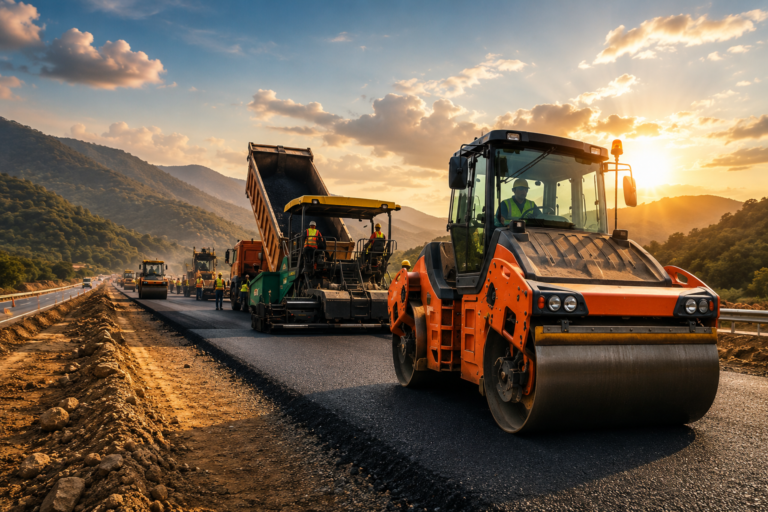
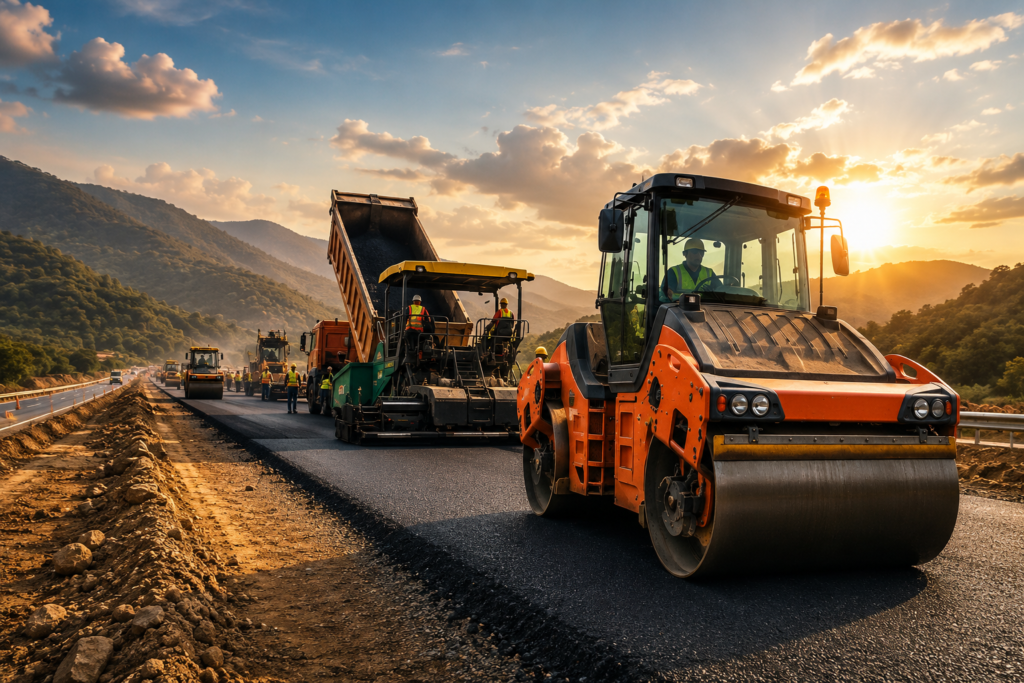
The equipment used on these projects covers several stages of the road-building process. Excavators and loaders handle earthworks. Motor graders establish formation levels. Asphalt plants produce paving material, while pavers place it and rollers compact the finished layers.
Technology is also becoming part of the process. MoRTH’s Automated & Intelligent Machine-aided Construction (AIMC) framework covers GPS-aided grading, intelligent compaction and stringless paving.
Road construction begins long before the first asphalt layer is placed.
Crawler excavators are used for excavation and earthmoving, while wheel loaders handle aggregates and other bulk materials. Backhoe loaders remain useful for smaller excavation, drainage and utility work.
JCB’s highway and road-construction portfolio in India includes excavators, backhoe loaders, single-drum soil compactors, telehandlers and vibratory tandem rollers.
The choice of machine depends on the scale and nature of the work. Large earthworks may require higher-capacity excavators, while drainage, utility and finishing activities call for smaller and more versatile machines.
Motor graders are used to prepare and finish the required surface profile before later pavement layers are constructed.
MoRTH’s AIMC framework specifies GPS-aided motor graders for highway construction. The system uses an RTK base station to provide corrections to the positioning system. MoRTH states that RTK can improve positioning accuracy from metres to centimetres.
The framework also specifies a minimum GNSS position-update rate of 20 Hz.
The operator remains responsible for operating the grader. The digital system provides positioning and machine-control information to help achieve the specified grade and alignment.
Once the road formation is ready, asphalt production becomes a major part of the paving operation.
Ammann’s Indian road-construction portfolio includes Apollo asphalt plants as well as asphalt pavers. The company’s India range covers asphalt production equipment for road projects.
The plant has to maintain a consistent supply of paving material to keep the paving operation moving. Production capacity, material supply and transport distance all affect how effectively the paver can be used.
For large highway projects, this coordination between plant and paving operation is as important as the nominal capacity of an individual machine.
The paver distributes the asphalt mix and forms the required layer before final compaction.
Ammann currently lists the AP 550, AP 600, AP 1000 and WM 6 in its Indian asphalt-paver range. The AP 550 has a maximum paving width of 5.75 m and a stated paving output of 300 t/h. The AP 600 has a maximum width of 7.0 m and an output of 500 t/h.
The AP 1000 is a tracked paver with a maximum paving width of 9.5 m and a stated paving output of 700 t/h. Ammann describes it for wider paving applications, including national highways, expressways and other large infrastructure projects.
The WM 6 is a mechanical paver finisher with a maximum paving width of 4.5 m and a stated output of 150–200 t/h.
These machines are not interchangeable. Required paving width, production rate, material supply and project configuration determine which paver is suitable.
After the asphalt is laid, rollers compact the pavement to achieve the required density.
JCB’s Indian road-equipment range includes the VM117 single-drum soil compactor and VMT300 vibratory tandem roller.
The VM117 is specified with an 11-tonne operating weight and is listed for applications including roads, highways and expressways. The VMT300 is a smaller tandem roller intended for applications including road repairs and maintenance.
Ammann also manufactures soil and asphalt compactors for road construction alongside its paver range.
Compaction performance depends on several variables, including material temperature, layer thickness, roller passes and operating settings. The roller itself is only one part of the process.
Road construction is also moving towards greater use of machine and positioning data.
MoRTH’s AIMC framework includes intelligent compaction rollers as part of its technology approach for highway construction.
Ammann’s ACE compaction technology is another example. The company says its system can automatically adjust amplitude and frequency according to ground conditions on equipped machines.
The purpose is to give operators more information about the compaction process and reduce reliance on manually tracking passes alone.
NHAI’s March 2026 publication identified AIMC, Drone Analytics and Management Systems, Mobile Quality Control Vans and Network Survey Vehicles among technologies associated with National Highway construction and maintenance.
Highway work also includes rehabilitation of existing pavement.
Wirtgen’s India portfolio covers cold milling machines, cold recyclers and stabilisers, binding-agent spreaders and slipform pavers.
Its cold recyclers process existing asphalt pavement in place by granulating and mixing the material with controlled additions of water and binding agents. Wirtgen says the process can be used for structural road rehabilitation.
Soil stabilisers use the same basic milling-and-mixing principle to incorporate binding agents such as lime or cement into weaker soils.
These technologies allow contractors to reuse existing pavement materials in applications where recycling or stabilisation is appropriate.
A highway project can require a sequence of machines rather than one dominant equipment type.
Earthmoving equipment prepares the formation. Graders establish levels. Material-processing equipment supplies aggregates where required. Asphalt plants produce the mix. Pavers place it, and compactors complete the pavement structure.
Digital systems increasingly sit across that equipment chain.
MoRTH’s AIMC framework brings positioning, machine guidance and intelligent compaction into the construction process. NHAI’s technology programme also includes drone-based analysis and network-survey systems.
The direction is clear even though adoption will vary between projects. Equipment is becoming more closely connected to survey data, machine-control systems and construction-quality monitoring.
ICEMA recorded 140,191 construction-equipment units sold in India in FY2025. Earthmoving equipment remained the largest segment, while road-construction equipment accounted for 7,002 units and concrete equipment for 14,473 units.
Road equipment represents only one part of the overall market. Highway construction, however, creates demand across several connected equipment categories, including excavators, loaders, graders, asphalt plants, pavers, compactors and rehabilitation machinery.
The scale of road construction also means productivity matters. Keeping a paver supplied, maintaining compaction quality and coordinating machines across long project stretches can have a direct effect on project execution.
For equipment buyers, the useful comparison is rarely just machine horsepower or rated capacity.
An excavator has to match the excavation workload. A grader needs the right control and positioning capability for the required tolerances. The asphalt plant and paver have to work at compatible production rates. Rollers need to achieve the required compaction within the paving window.
On projects using AIMC or similar digital methods, machine-control capability and positioning systems can become part of the equipment requirement itself.
India’s highway programme is therefore creating demand not only for more equipment, but for equipment that can operate as part of a coordinated construction process.