India’s rail and metro construction programme spans long-distance railway lines, freight corridors, elevated metro systems and underground sections. Each type of project calls for a different mix of construction equipment.

India’s rail and metro construction programme spans long-distance railway lines, freight corridors, elevated metro systems and underground sections. Each type of project calls for a different mix of construction equipment.
The current railway pipeline is substantial. As of April 1, 2026, Indian Railways had 514 sanctioned infrastructure projects covering 40,000 km at an estimated cost of ₹8.31 lakh crore. The programme included 169 new-line projects, 29 gauge-conversion projects and 316 doubling projects. Of the total length, 12,583 km had been commissioned by March 2026.
For equipment suppliers, that scale does not translate into one standard fleet. Earthwork, foundations, bridges, viaducts, stations and underground construction bring different machine requirements.
Earthmoving is a basic requirement on many railway civil-construction packages. Excavators can be used for site preparation, excavation and foundation-related work, with machine size selected according to the volume of material, working conditions and access available at the site.
New-line and capacity-expansion projects can extend across long corridors, making fleet deployment different from that on a compact urban project. Contractors may need machines distributed across several work fronts rather than concentrated at one location.
Loaders and other material-handling equipment can support movement of excavated material and construction inputs. The fleet mix depends on the project package and how material is handled on site.
Foundation work becomes more important on bridges, elevated metro structures, stations and other major civil structures.
Piling rigs are used where deep foundations are required. Bored piling is one of the established methods used for such foundations, while continuous-flight-auger systems are another option where project and ground conditions suit the method.
Underground metro construction can also require diaphragm-wall equipment for deep excavations and retaining structures. The machine and method depend on factors such as bore diameter, drilling depth, soil conditions, groundwater and available working space.
For contractors, foundation equipment is therefore more application-specific than general earthmoving machinery.
Cranes are used on rail and metro projects for lifting structural and precast components, reinforcement, formwork and other materials.
Bridge projects can require mobile or crawler cranes depending on the load, lifting radius, boom configuration and ground conditions. Metro construction adds lifting requirements around elevated viaducts and stations, where precast elements may need to be positioned along the alignment.
The rated capacity of a crane is only one part of the selection process. The usable lifting capacity changes with working radius, boom length, counterweight and other configuration factors.
Concrete-production and placing equipment supports foundations, piers, stations, bridges and other civil structures.
Batching systems can supply concrete to project sites, while transit mixers and concrete pumps move and place it where required. The scale and layout of a project can determine how many production or placing points are needed.
Long railway and metro projects also create a logistics issue because concrete and other materials may need to be supplied across multiple work fronts. Equipment deployment consequently depends on project length, construction sequence and site access.
Metro projects often involve construction within built-up urban areas. The resulting site constraints can influence equipment selection as much as machine output.
India had more than 1,155 km of operational metro network by 2026. Metro connectivity had expanded to 26 cities by 2025, while daily metro ridership had exceeded 1.15 crore passengers.
An urban metro project may include elevated viaducts, stations and underground sections within restricted working areas. Equipment may have to operate around existing roads, buildings and traffic-management arrangements.
That can make transport dimensions, turning space, working height and access important selection criteria. A machine that is suitable for an open railway construction site may not be practical in a constrained urban work zone.
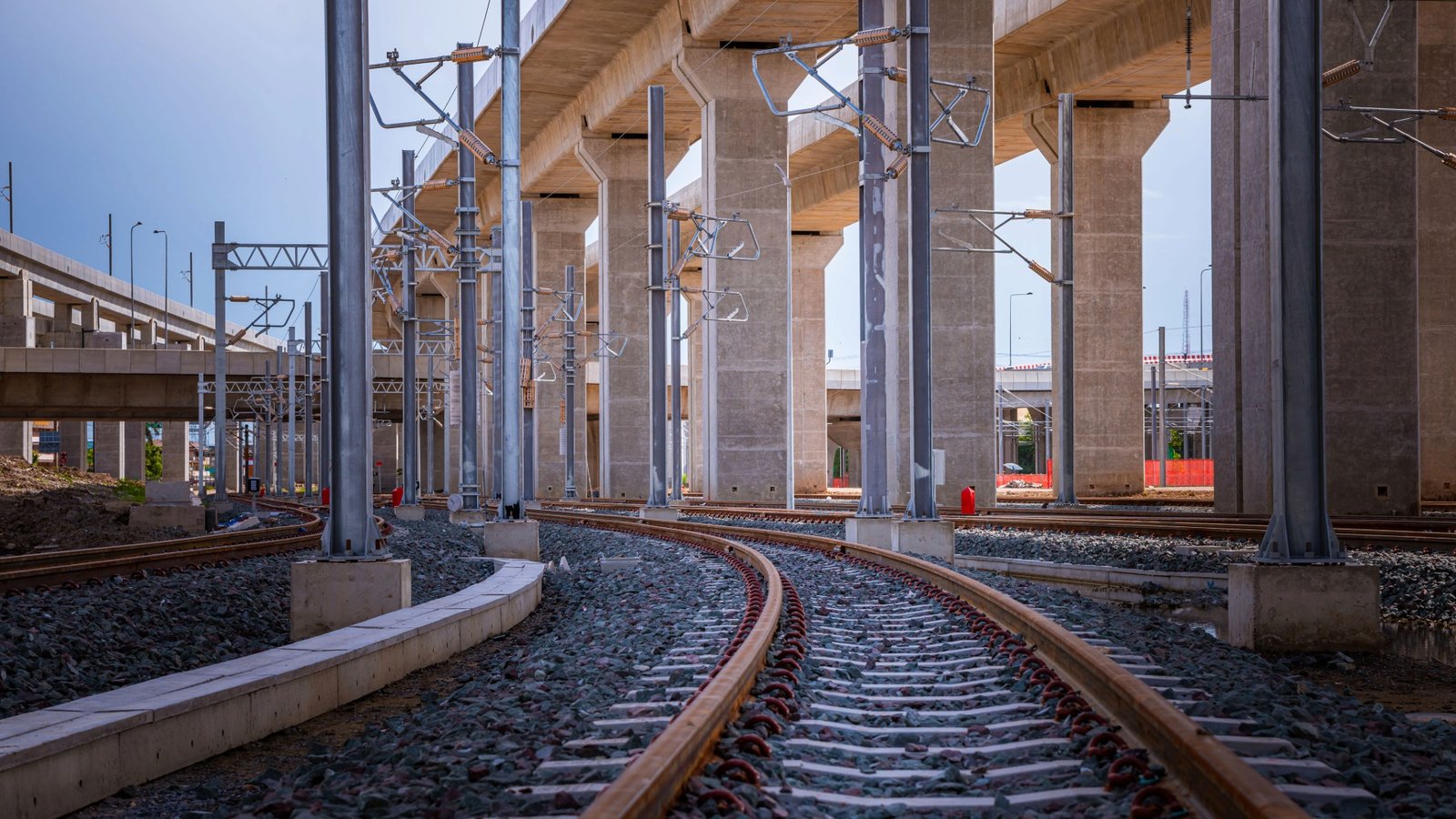
The construction method changes the equipment requirement.
Elevated corridors can involve piling, foundation construction, pier work and lifting of precast elements. Underground packages can shift the requirement toward excavation, retaining-wall construction, lifting and equipment suited to restricted working environments.
The same metro project can therefore require several equipment categories at different stages rather than one fixed fleet throughout construction.
Jaipur Metro Phase 2 illustrates the scale of some of these projects. The Union Cabinet approved the 41 km North-South corridor from Prahladpura to Todi Mod on April 8, 2026. The project includes 36 stations and has a total cost of ₹13,037.66 crore. It is being implemented by Rajasthan Metro Rail Corporation Limited as a 50:50 joint venture between the Government of India and the Government of Rajasthan.
India’s two Dedicated Freight Corridors form another major part of the railway infrastructure programme.
The Eastern Dedicated Freight Corridor runs from Ludhiana to Sonnagar for 1,337 km. The Western Dedicated Freight Corridor runs from Dadri to Jawaharlal Nehru Port Terminal for 1,506 km. Both have been commissioned.
Long corridor projects can involve multiple civil-construction work fronts over extended periods. Equipment requirements can consequently change as work moves from earthwork and structures to other stages of construction.
For equipment suppliers and rental companies, the important consideration is not simply the corridor length but the number and type of active construction packages at any given time.
The 514 sanctioned railway projects cover three distinct categories: new lines, gauge conversion and doubling. Their combined scale is large, but their construction requirements are not identical.
A new-line project can involve substantial formation work, drainage, bridges and other civil structures. Doubling work can take place alongside an existing operational railway, creating different access and sequencing constraints. Bridge and station packages may require more lifting and foundation equipment than a section dominated by earthworks.
This difference matters when forecasting equipment demand. Project value alone does not indicate which machine categories will be required or when.
A sanctioned project does not immediately require its full equipment fleet.
Work progresses through design, tendering, award, mobilisation and successive construction stages. Machine requirements can change as a project moves from excavation and foundations into structures, paving, station construction or finishing work.
The current railway data shows that 12,583 km of the 40,000 km covered by the 514 sanctioned projects had been commissioned by March 2026.
For manufacturers, dealers and rental companies, this makes project-stage tracking important. The machines required by a contractor beginning bulk excavation can be very different from those needed later for bridge construction, precast installation or station work.
Rail and metro expansion supports demand across several equipment categories, but the effect is project-specific.
Excavators and loaders remain important for earthwork. Piling and foundation equipment becomes critical where deep foundations are required. Cranes support bridge, viaduct and station construction. Concrete equipment is used across structural work, while underground and constrained urban projects may require more specialised machinery.
The key commercial variable is therefore not simply the value of India’s rail and metro pipeline. It is the type of construction package being executed, the project stage, the site conditions and the equipment required for that stage of work.
For the construction-equipment industry, that is what makes India’s railway and metro expansion a broad equipment market rather than a single-category growth story.