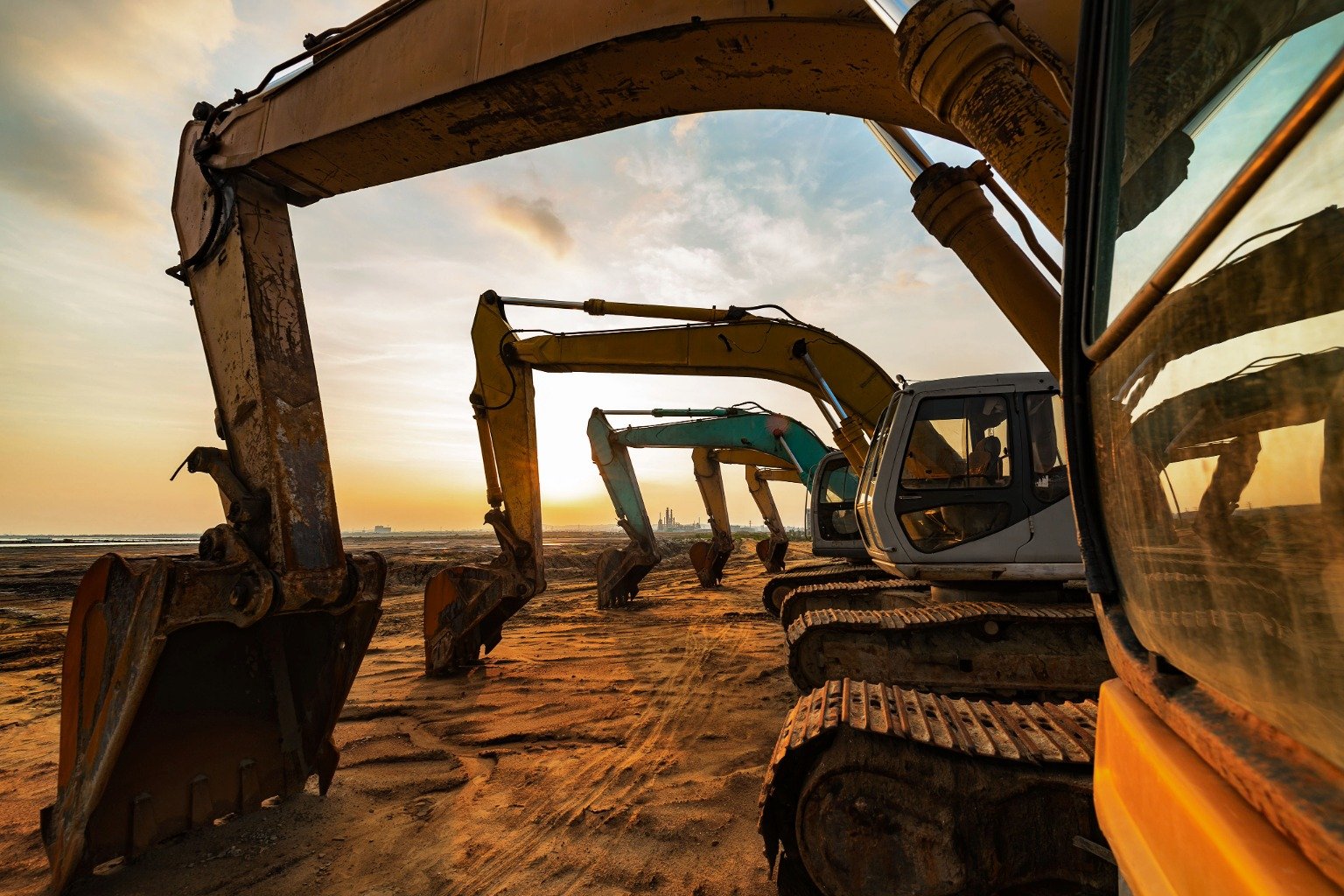
The latest equipment sales data illustrates the difference. India’s construction-equipment industry sold 136,995 units in FY2025-26, down about 2% from 140,191 units in FY2024-25. Domestic sales fell 6.7% to 113,229 units, while exports rose 31.5% to 17,394 units.
The result is a market where a large infrastructure pipeline does not automatically translate into higher equipment sales across every category.
Public Capital Spending Supports the Pipeline
The Union Budget for FY2026-27 provides ₹12.22 lakh crore for capital expenditure. When grants-in-aid for creation of capital assets are included, the Union government’s effective capital expenditure is estimated at ₹17.15 lakh crore.
The project pipeline remains substantial. MoSPI’s PAIMANA platform was monitoring 1,847 ongoing Central Sector infrastructure projects worth ₹40.54 lakh crore as of June 2026. The portfolio included 769 mega projects costing ₹1,000 crore or more, with a combined revised cost of ₹30.51 lakh crore. Transport and Logistics accounted for 1,341 projects worth ₹22.32 lakh crore.
Those numbers indicate the scale of infrastructure activity, but they should not be read as an immediate equipment-sales forecast. PAIMANA covers projects at different stages of development, and equipment demand changes as work moves from award and mobilisation into excavation, structures, paving, finishing and commissioning.
The June 2026 data showed that around 709 projects had crossed 80% physical progress, while about 337 had exceeded 80% financial completion.
Highways Continue to Shape Earthmoving Demand
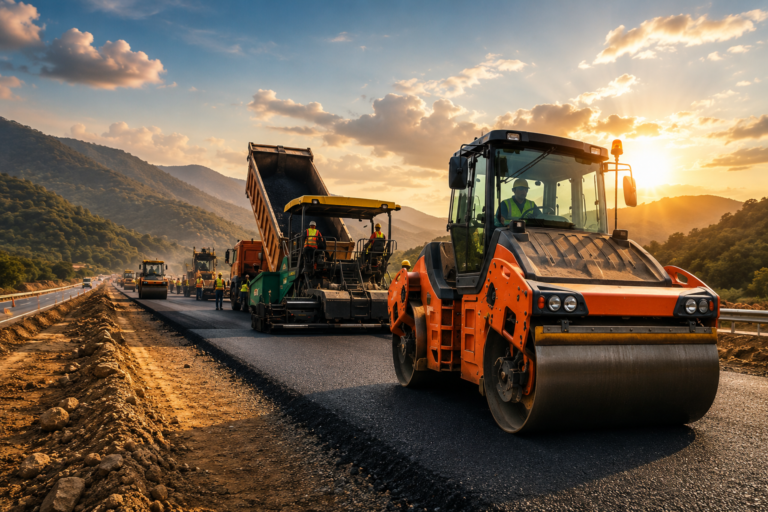
Highway construction remains an important market for earthmoving and road-building equipment.
MoRTH reported 12,349 km of National Highway construction in FY2023-24, along with 9,642 km of lane augmentation. Roads of four lanes and above, including expressways and access-controlled highways, accounted for 5,193 km. The ministry reported a construction pace of about 33.8 km per day during that year.
These figures are historical rather than current FY2026-27 output, but they show the scale of road-building activity that supports equipment demand.
Highway projects can involve excavators and loaders during earthwork, graders and compactors during formation and pavement preparation, and pavers and rollers during surfacing. Crushing, screening and asphalt-production equipment may also be required depending on how aggregate and mix supply is organised.
The equipment-sales data shows that road construction has behaved differently from the wider market. Road-construction equipment sales increased 6.3% to 7,445 units in FY2025-26, while total construction-equipment sales declined about 2%.
That divergence is important for manufacturers. Infrastructure growth does not produce the same demand pattern in every equipment category.
Rail Expansion Creates a Broader Equipment Mix
Rail infrastructure involves more than track construction. Projects can include new lines, doubling, bridges, stations, earthworks and other civil structures, creating equipment requirements that vary significantly by package.
As of April 1, 2026, Indian Railways had 514 sanctioned infrastructure projects covering about 40,000 km, with an estimated cost of ₹8.31 lakh crore. The total included 169 new-line projects, 29 gauge-conversion projects and 316 doubling projects.
The two Dedicated Freight Corridors are also commissioned. The Eastern DFC extends from Ludhiana to Sonnagar over 1,337 km, while the Western DFC runs from Dadri to Jawaharlal Nehru Port Terminal over 1,506 km.
For equipment suppliers, this kind of project mix can support demand across excavation, foundation work, lifting, concrete placement and material handling. The actual requirement depends on the work package and construction method rather than the railway project label alone.
Metro Expansion Favors Specialised Urban Equipment
Metro construction presents a different set of site conditions. Work is often carried out in constrained urban locations and can involve elevated structures, underground sections, stations, foundations and segment handling.
India’s metro network had expanded to more than 1,155 km by 2026. The number of cities with metro connectivity reached 26 in 2025, while daily ridership exceeded 1.15 crore passengers.
A metro package can therefore call for a combination of excavation, piling, diaphragm-wall and lifting equipment, together with concrete and material-handling machinery. The balance changes substantially between elevated, underground and station-focused packages.
Jaipur Metro Phase 2 is a current example. The Union Cabinet approved the 41 km North-South corridor in April 2026 at a project cost of ₹13,037.66 crore, with 36 stations. The project was subsequently included in PAIMANA’s July 2026 monitoring update.
Airports and Industrial Projects Add Other Requirements
Airport construction adds another part of the equipment market.
Government data shows that the number of operational airports increased to 165 in July 2026, from 74 in 2014. Twenty-five greenfield airports had been approved after 2014. The Modified UDAN scheme, approved in March 2026, has an outlay of ₹28,840 crore for FY2026-27 to FY2035-36.
Airport projects can involve bulk earthworks, pavement construction, foundations, structural work and material handling. The equipment requirement varies by project stage and by whether the work involves runways, aprons, terminals or associated infrastructure.
The wider Central Sector infrastructure pipeline also includes power, coal, petroleum, steel, mining and other projects. In July 2026, PAIMANA was tracking 98 Ministry of Power projects worth ₹6.08 lakh crore, 121 Ministry of Coal projects worth ₹2.22 lakh crore and 27 Ministry of Steel projects worth ₹30,000 crore. The July portfolio also included projects from the Ministry of Petroleum and Natural Gas, the Ministry of Mines and other departments.
These projects can involve large excavation, lifting, haulage and material-handling requirements, but equipment selection depends on the particular project and construction process.
Earthmoving Remains the Largest Equipment Segment
Despite the diversification of infrastructure work, earthmoving equipment continues to dominate India’s construction-equipment market.
ICEMA data shows earthmoving equipment sales of 97,236 units in FY2025-26, representing about 71% of the market and a 2% decline from the previous year. Material-handling equipment sales fell 10% to 15,290 units. Concrete equipment was broadly stable at 14,486 units, up 0.09%. Road-construction equipment rose 6.3% to 7,445 units, while material-processing equipment increased 1.2% to 2,538 units.
The figures show why equipment demand needs to be viewed by category rather than through total infrastructure spending alone.
Earthmoving remains the volume base of the market. Road equipment recorded growth even as the overall market declined, while material handling contracted more sharply.
Project Execution Determines When Demand Reaches the Market
The gap between infrastructure spending and equipment sales becomes clearer when project execution is considered.
ICEMA attributed the decline in domestic equipment demand during FY2025-26 to slower infrastructure execution and project delays, alongside land-acquisition challenges, slower disbursement cycles, higher equipment costs following the move to CEV Stage V emissions standards, financing pressures and rising commodity costs.
This explains why a project pipeline can remain large while equipment sales weaken in a particular period.
A sanctioned project does not immediately require its full equipment fleet. Demand typically builds as contractors receive work orders, mobilise to site and move through successive construction stages. Equipment requirements also change during the project. The machines needed for bulk excavation are not necessarily the machines required during structures, paving or finishing.
For manufacturers, dealers and rental companies, the timing of this transition matters almost as much as the total value of the infrastructure programme.
What This Means for Equipment Buyers
Contractors are increasingly buying equipment according to application rather than simply adding capacity to the fleet.
Earthmoving machines remain central to general infrastructure work, but specialised projects can require piling equipment, cranes, concrete machinery, road-construction equipment and material-processing systems. The appropriate fleet depends on the type of work, project duration, expected utilisation, site conditions and transport requirements.
Equipment utilisation also matters. A large project does not automatically justify a larger owned fleet if existing machines can be redeployed between sites. Connected-machine data can support that assessment by providing information on operating hours, utilisation, location and maintenance status.
The wider market data suggests that this application-based approach is becoming more important. FY2025-26 combined a decline in total equipment sales with strong export growth and differing results across major equipment segments.
The Infrastructure Pipeline Is Diversifying Equipment Demand
India’s infrastructure build-out is broadening the range of equipment used across major projects, but the effect is not uniform.
Highways continue to support large volumes of earthmoving and road-construction equipment. Rail and metro projects add demand for equipment used in foundations, structures, lifting and underground work. Airports and industrial projects create requirements that can include heavy lifting, excavation and material handling.
At the same time, the FY2025-26 market shows that project execution, financing, input costs and award schedules can offset the effect of high infrastructure spending in the short term. For the equipment industry, the key indicator is therefore not only the size of India’s infrastructure pipeline, but which projects are moving into construction, what stage they have reached and which equipment categories that work requires.