A recent government technology briefing offers practical lessons for wastewater EPC teams: a smaller plant footprint must still leave room to operate, maintain and replace equipment.

A recent government technology briefing offers practical lessons for wastewater EPC teams: a smaller plant footprint must still leave room to operate, maintain and replace equipment.
Space-constrained sewage treatment projects demand more than a smaller reactor. Pumps must remain accessible, screens need cleaning, and sludge must leave the site. A government briefing published on 21 October 2026 brings these issues into focus through examples of compact, vertical and decentralised treatment under Namami Gange.
For Indian wastewater contractors and equipment suppliers, the useful message is that the treatment process, civil structure and maintenance arrangement have to be designed together. A compact layout can reduce the land requirement while creating a more demanding equipment installation.
The PIB technology backgrounder reviews existing programme experience. It is not a new tender, contract award or announcement that every listed technology will be used on future projects.
The document describes a technology-neutral approach, including conventional biological treatment, sequencing batch reactors, moving-bed biofilm systems, constructed wetlands and packaged plants. It highlights the 7.5-million-litres-per-day, four-storey municipal STP at Muni Ki Reti, Chandreshwar Nagar, which occupies approximately 900 square metres. It also discusses an on-site treatment pilot at Varanasi’s Assi Drain whose payments are linked to treated-water quantity and performance indicators.
These are different responses to different constraints. Neither is a universal template for an Indian municipal STP. Site conditions and the contracted effluent standard still determine the engineering choice.
Equipment Brief analysis: in a vertical plant, equipment removal deserves the same attention as equipment installation. A pump that can be lowered into place during construction may be difficult to replace after floors, pipework and electrical services are complete.
The design review should therefore trace the removal route for the largest maintainable component. That includes lifting points, access openings, working clearances and the load capacity of the route. A crane standing area or a permanent hoist can consume space that a simple reactor-area comparison overlooks.
Access also affects daily work. Operators need to reach instruments, isolation valves and sampling points without dismantling unrelated equipment. These details belong in the layout and equipment package before procurement, when changes are easier to accommodate.
Area per unit of treatment capacity can be useful, but only when both proposals include the same facilities. One bidder may quote the biological reactor footprint while another includes inlet works, electrical rooms, sludge handling, access and treated-water storage.
A meaningful comparison should identify those boundaries explicitly. The same discipline applies to power consumption: treatment equipment, pumping, ventilation and auxiliary loads should be included or excluded consistently. A compact process should not receive credit for energy savings that depend on a different inlet level or pumping arrangement.
For suppliers, the practical opportunity is to present equipment as part of an operable system. Installation drawings, lifting requirements, isolation arrangements and spare-parts access can be as valuable to an EPC team as a headline efficiency figure.
Where a contract links payment to treated volume and water quality, the measurement system becomes commercially important. Meter locations, calibration, sampling frequency and the treatment of abnormal incoming loads need clear agreement.
Project teams should also establish who maintains the instruments and how disputes are resolved when equipment is unavailable or incoming sewage differs from the design basis. These are contract-specific matters; the Assi Drain example does not establish payment terms for other projects.
Before releasing equipment orders, the project team should record four checks:
Resolving these interfaces before procurement helps prevent costs from shifting out of the initial civil package into years of operation.
Water-infrastructure engineering also depends on a clear operating boundary between interconnected systems. Equipment Brief’s report on the Narmada–Jhabua pressurised irrigation project examines that issue at the interface between bulk-water distribution and field equipment.
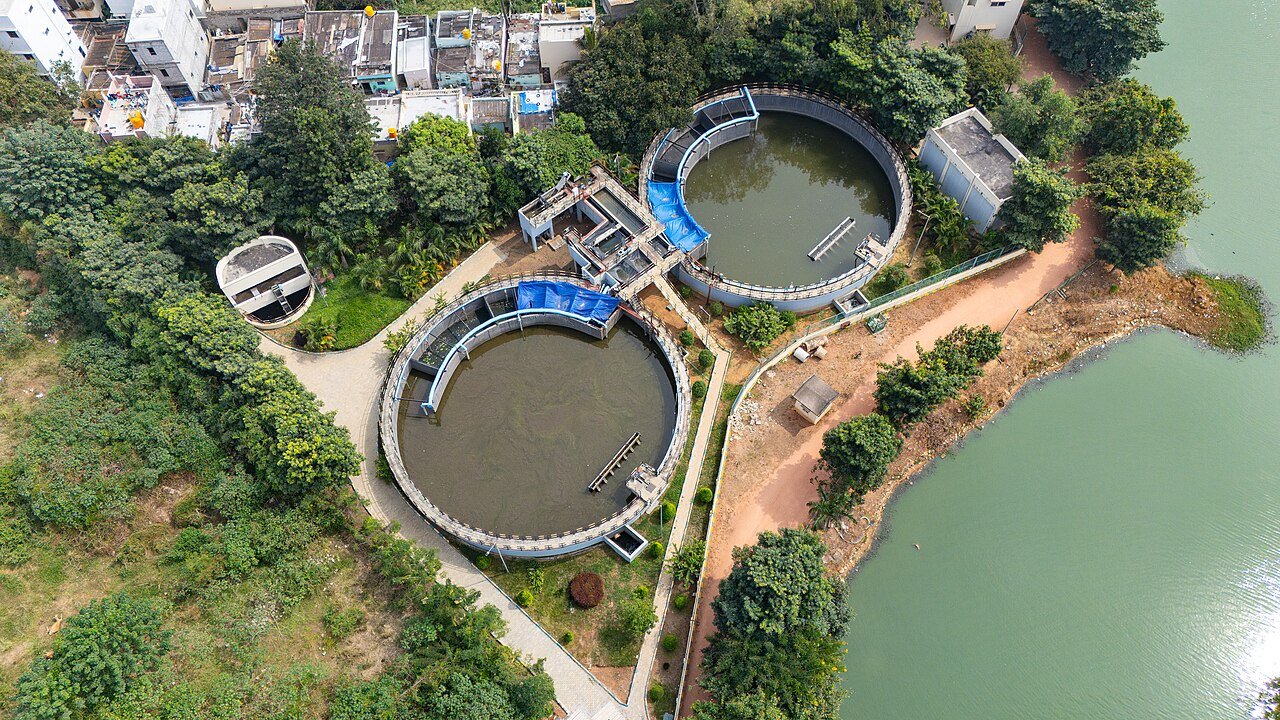
Featured photograph: Doddabommasandra Lake STP, Bengaluru, photographed in November 2025. This is a representative wastewater facility, not one of the Namami Gange installations discussed above. Photo: Vraj Acharya, WELL Labs, via Wikimedia Commons, CC BY-SA 4.0. Resized for publication; theme crops may vary. The photograph and its resized versions retain that licence.