The Mumbai–Ahmedabad High-Speed Rail project has reached 62.16% physical progress, with viaduct, tunnelling, track, station and depot work advancing across the 508-km corridor.

The Mumbai–Ahmedabad High-Speed Rail project has reached 62.16% physical progress, with viaduct, tunnelling, track, station and depot work advancing across the 508-km corridor.
The Mumbai–Ahmedabad High-Speed Rail (MAHSR) project had reached 62.16% overall physical progress by July 2026, according to a reply issued by the National High Speed Rail Corporation Limited (NHSRCL) under the Right to Information (RTI) Act on 21 September 2026 and reported by India Today. The update shows the project advancing across viaducts, tunnelling, track systems, stations and related systems.
The 508-km corridor runs through Gujarat, Maharashtra and the Union Territory of Dadra and Nagar Haveli. NHSRCL has said that all 1,389.49 hectares required for the project have now been acquired. The latest progress reported from the RTI response includes foundation work along 459.90 km, completed piers along 455.10 km, girders cast for about 380 km and girders erected along about 366 km of viaduct.
Project snapshot
More than 366 km of viaduct girders have been erected, making the elevated structure one of the project’s most visible construction workstreams. The scale of completed foundations, piers and girder erection also illustrates how the corridor is shifting from isolated civil packages towards continuous system construction. For broader context on equipment demand across major Indian infrastructure projects, see Equipment Brief’s mega-infrastructure equipment analysis.
For the construction-equipment industry, this phase is relevant because it combines heavy lifting, precast concrete production and transport, segment handling and high-volume site logistics across a long, linear workfront. These are industry implications of the reported construction program rather than equipment quantities specified by NHSRCL. The broader role of foundation equipment in major Indian infrastructure projects is covered in Equipment Brief’s analysis of piling technology.
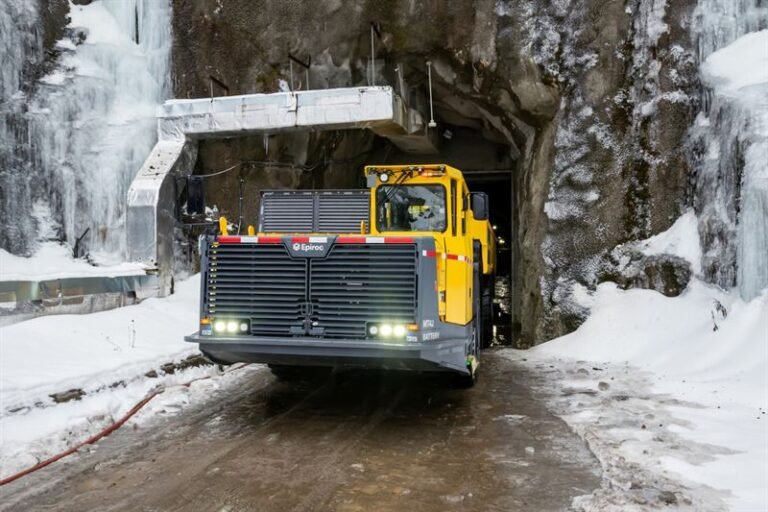
The corridor includes a 21-km tunnel, including a 7-km under-sea section. The latest RTI-based update says tunnel boring machine work is under way, while 4.88 km of tunnelling constructed using the New Austrian Tunnelling Method has been completed. Excavation has also broken through at four of the project’s eight mountain tunnels.
The tunnelling program is significant for contractors and equipment suppliers because the project is using more than one construction approach. TBM operations are being undertaken alongside conventional mountain-tunnelling work, creating different requirements for excavation, spoil handling, ground support, concrete and underground logistics.
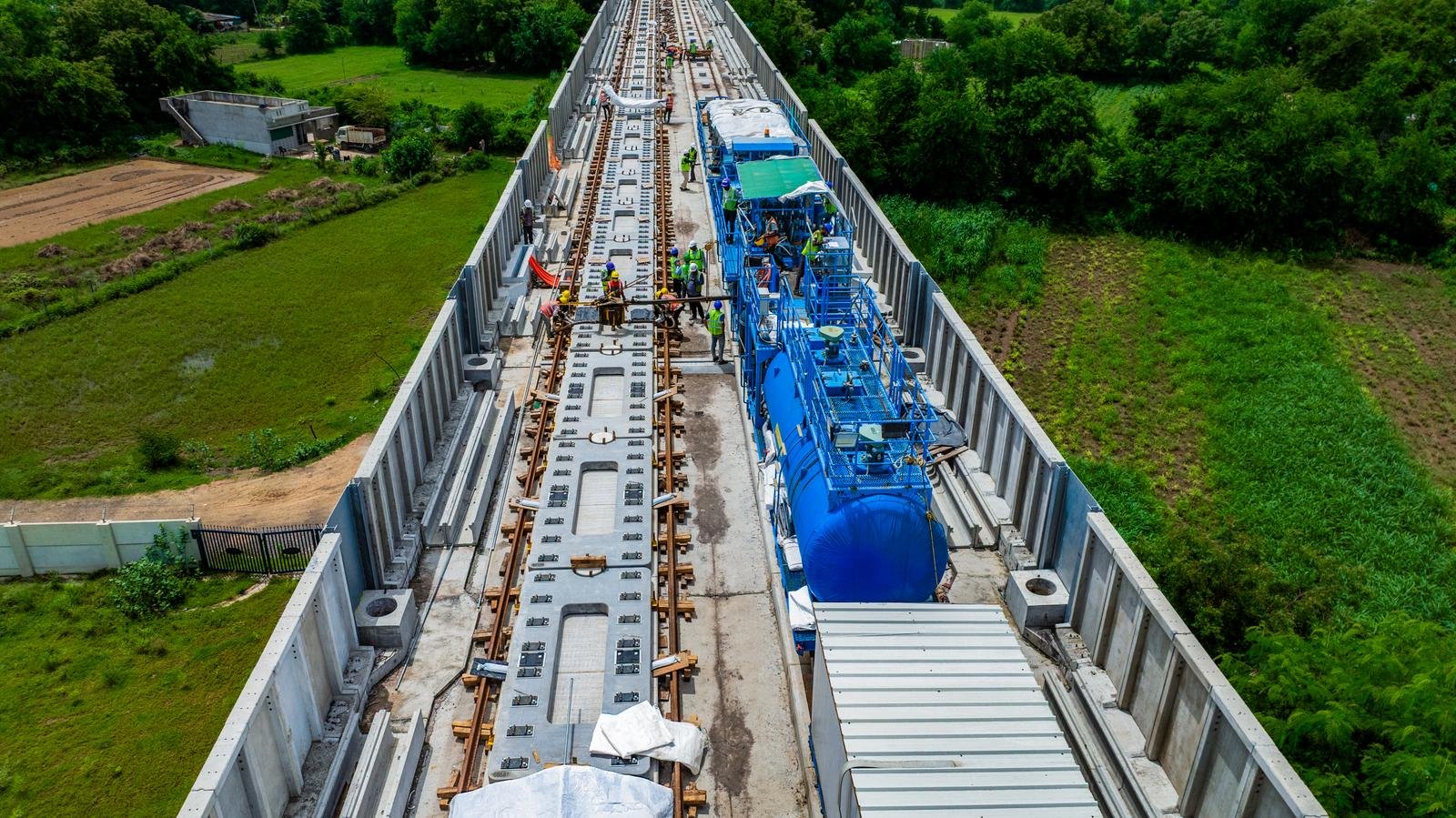
The project is also entering a more equipment-intensive track construction phase. As of 27 August 2026, track slabs had been laid along about 97 route kilometres, including cement asphalt mortar (CAM) injection work. The project uses a Japanese Shinkansen-based J-Slab ballastless track system, with dedicated track-slab manufacturing facilities established at Kim in Gujarat and Anand. Equipment Brief’s broader rail and metro equipment guide provides additional context on the machinery used across such projects.
NHSRCL has described the track system as comprising reinforced-concrete track beds, cement asphalt mortar, precast track slabs and rails with fasteners. The dedicated slab facilities are designed to provide dimensionally controlled components that can be transported to track construction bases and then moved to the viaduct.
Station construction is advancing at different rates along the corridor. The latest RTI response says foundation and superstructure work has been completed at all stations in Gujarat, with finishing work under way, while station construction continues in Maharashtra. Sabarmati depot was reported at 32.28% progress and the Thane depot at 17.23%.
The next phase of the MAHSR build-out will be defined by how quickly viaduct completion, tunnelling, track installation, electrification, station finishing and depot works converge. For India’s construction-equipment market, that convergence matters because it expands the project from a predominantly civil-engineering story into a multi-discipline deployment of specialist construction and handling systems.
For Equipment Brief, the key signal is not simply the headline completion percentage. It is the number of parallel workstreams now moving across the corridor—and the equipment, logistics and technology ecosystem required to keep those workstreams synchronized. The project also provides a useful case study of how large Indian infrastructure programs increasingly combine civil construction with specialized track, tunnelling and systems work. That sits alongside the wider shift in India’s construction-equipment industry toward larger domestic manufacturing and export capability, a trend examined in our construction-equipment export analysis.
Sources: National High Speed Rail Corporation Limited (NHSRCL); Press Information Bureau, Ministry of Railways; India Today report based on NHSRCL’s RTI response dated 21 September 2026.