CEV Stage V has been in force for India’s construction equipment since January 2025. Here is what the emission rules mean for machine engineering, costs, exports and the October 2026 monitoring milestone.

CEV Stage V has been in force for India’s construction equipment since January 2025. Here is what the emission rules mean for machine engineering, costs, exports and the October 2026 monitoring milestone.
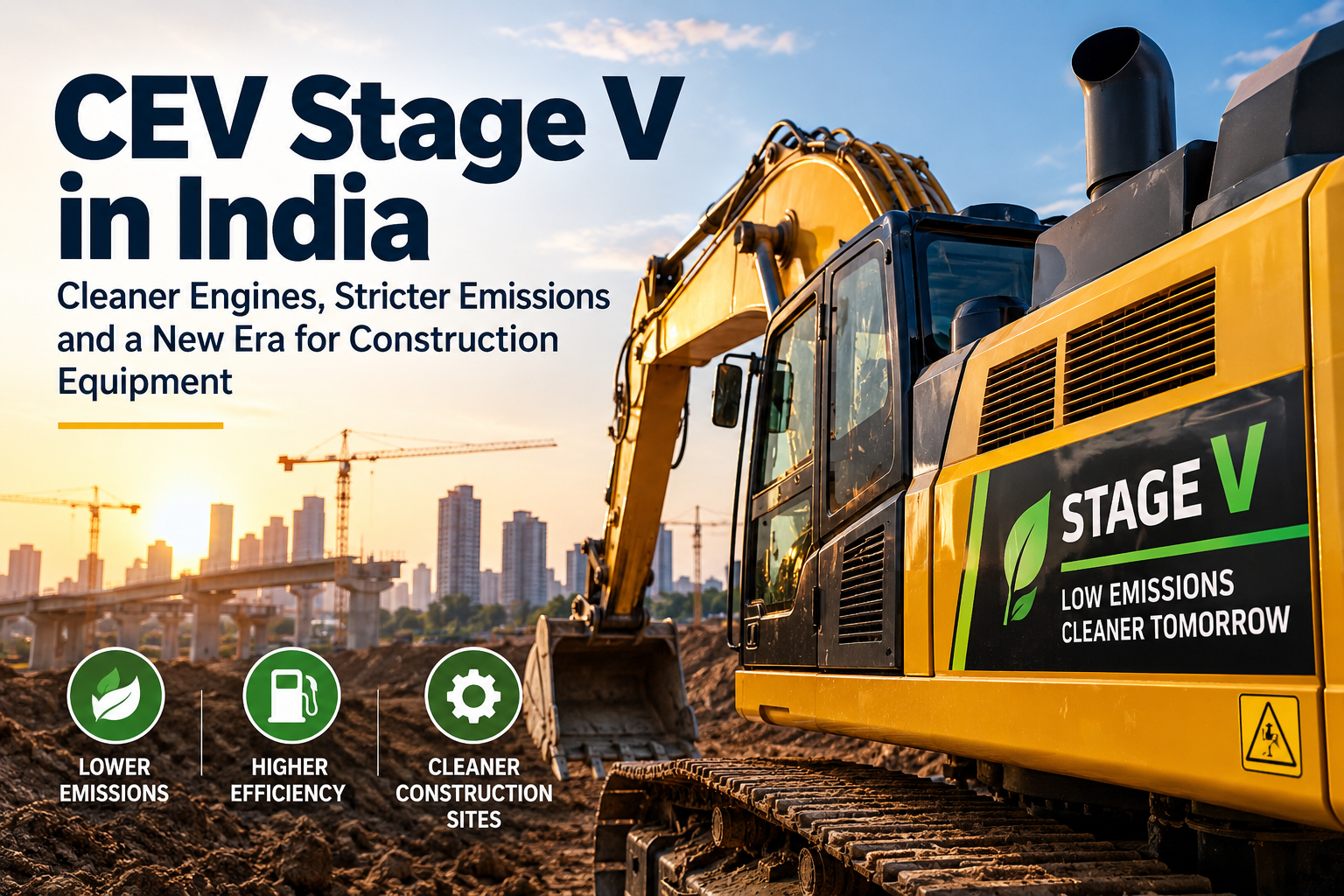
India’s construction-equipment industry has already moved into the CEV Stage V era. The emission stage for construction equipment vehicles took effect from 1 January 2025, following a government decision in March 2024 to defer the earlier 1 April 2024 date. A separate October 2026 milestone now concerns in-service emission monitoring for newly manufactured construction equipment vehicles, not the start of CEV Stage V itself. (Source: Ministry of Road Transport and Highways notifications)
That distinction matters because CEV Stage V is not simply a regulatory label. The transition requires tighter control of gaseous and particulate emissions and has changed the engineering, certification and cost equation for construction equipment sold in India. Its market impact sits within the wider equipment-demand picture covered in Equipment Brief’s heavy-equipment market analysis.
| Milestone | What it means |
|---|---|
| 1 April 2024 | Original CEV Stage V implementation date |
| 1 January 2025 | Revised CEV Stage V implementation date |
| 1 October 2026 | In-service emission monitoring trigger for construction equipment vehicles manufactured after this date |
The Ministry of Road Transport and Highways’ 2026 amendment restated the CEV Stage V applicability date at 1 January 2025 and separately introduced the later in-service monitoring trigger. The same notification also expanded the list of fuels covered by the rules, including hydrogen and HCNG. (Source: Ministry of Road Transport and Highways, GSR 542(E))
CEV Stage V tightens the emissions framework compared with the earlier Stage IV regime. The rules apply gaseous and particulate limits using the relevant Non-Road Steady Cycle (NRSC) and, where applicable, Non-Road Transient Cycle (NRTC) tests. For engines in the 19 kW to below 560 kW range, the Stage V framework includes a particulate-number limit of 1 × 10¹² particles per kWh and a particulate-mass limit of 0.015 g/kWh. (Source: Ministry of Road Transport and Highways, GSR 542(E))
For equipment manufacturers, meeting these limits is an engineering exercise rather than a single component upgrade. Engines, after-treatment systems, sensors, electronic controls and calibration have to work together to keep emissions within the prescribed limits under the applicable test cycles. That broader shift toward electronically managed machines is also covered in Equipment Brief’s coverage of electric and connected construction equipment.
The move to Stage V has affected machine economics as well as emissions compliance. Industry representatives told Business Standard that the transition to CEV Stage V increased construction-equipment prices by about 12–15% on average, while additional safety requirements for wheeled machines added further cost. The same industry reporting linked softer domestic demand in FY2026 partly to higher equipment prices following the emissions transition. These are industry estimates and attributed claims, rather than a government-mandated price increase. (Source: Business Standard, citing ICEMA industry representatives)
That cost transition also needs to be read alongside the industry’s export performance. Equipment Brief has tracked the shift in Indian construction-equipment exports as Stage V compliance improves access to more demanding overseas markets in its analysis of India’s construction-equipment export push.
For fleet owners and contractors, that makes the comparison between older and newer machines more complicated. Acquisition price is only one part of the decision; financing, fuel consumption, maintenance and machine utilisation also affect the economics of a Stage V fleet.
The compliance shift has created an important second effect: Indian-made construction equipment is increasingly aligned with emissions requirements in developed export markets. ICEMA said construction-equipment exports rose by roughly 32% in FY2026 to about 17,394 units, while industry reporting linked the export opportunity partly to India’s move to stricter emissions standards. (Sources: Business Standard; Economic Times, citing ICEMA)
That connection is important for manufacturers building India-based production platforms. Equipment engineered for more demanding emissions regimes can potentially address a wider range of export markets, subject to the requirements of each destination.
The next major compliance milestone is the in-service emission monitoring provision for construction equipment vehicles manufactured after 1 October 2026. The 30 June 2026 amendment sets the trigger and points to AIS:137 for the monitoring procedure. It should therefore be understood as a field-monitoring requirement, not as a new date for CEV Stage V itself. (Sources: Ministry of Road Transport and Highways; GSAS analysis of the notification)
CEV Stage V is pushing the market toward more electronically managed powertrains, tighter calibration and greater compliance discipline. It also creates a clear link between regulation, machine pricing and export competitiveness.
For Equipment Brief, the more important story is what comes next: whether the higher engineering content of Stage V machines translates into measurable gains in fuel efficiency, reliability and export reach, and how manufacturers and fleet operators respond as in-service monitoring becomes part of the equipment lifecycle.
Sources: Ministry of Road Transport and Highways; Central Motor Vehicles Rules amendments including GSR 163(E) and GSR 542(E); Indian Construction Equipment Manufacturers’ Association (ICEMA); Business Standard industry reporting.